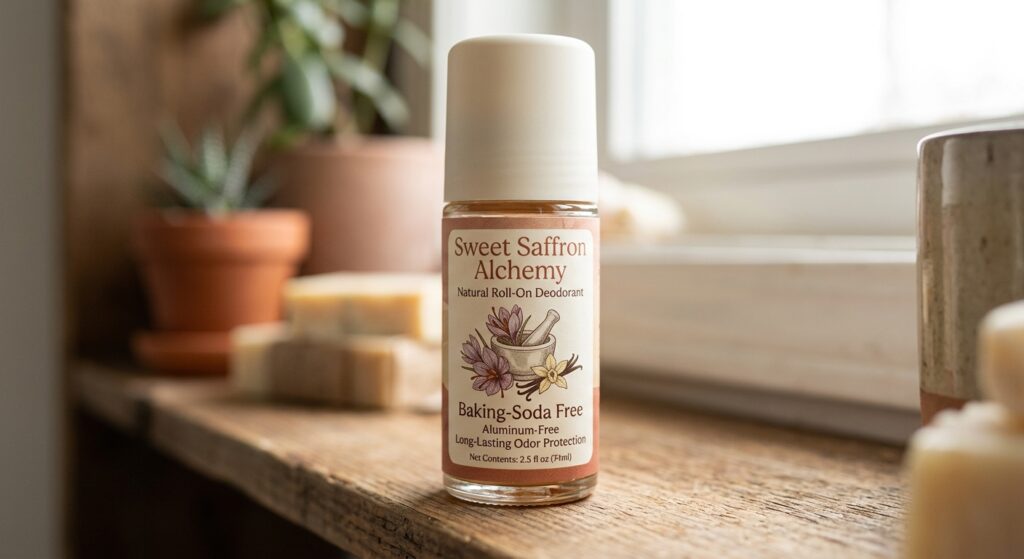
Hey pretty mama! I get asked about this a lot, so let’s talk formulator-to-friend about why baking soda in deodorant is such a common irritant, what’s actually happening on your skin, and what I use instead in my own formulations.
Have you ever switched to a “natural” deodorant and ended up with red, itchy, angry underarms for a few days? It’s very likely the baking soda in deodorant which is the culprit!
Why Baking Soda Shows Up in Natural Deodorants So Often
Baking soda (Sodium Bicarbonate) is cheap, easy to source, and genuinely great at neutralizing odour. It raises the pH of your underarm environment just enough to make it inhospitable for the bacteria that cause body odour.
On paper, that sounds perfect — no aluminium, no synthetic fragrance, just a humble kitchen ingredient doing its job.
This is exactly why baking soda in deodorant is so common in “clean beauty” and DIY recipes. It works, fast, and it’s familiar. But natural doesn’t automatically mean gentle — and this is where the trouble starts.
The Real Problem: pH Mismatch
Here’s the science bit, explained simply.
Your skin has a natural protective layer called the acid mantle, and it sits at a pH of roughly 4.5 to 5.5 — slightly acidic. This acidity is what keeps your skin barrier intact, holds moisture in, and keeps unfriendly bacteria in check.
Baking soda, on the other hand, has a pH of around 8 to 9. That’s significantly alkaline!
When you apply something that’s alkaline directly onto skin, especially skin as thin and delicate as your underarms, you’re disrupting that acid mantle every single day. Over time, this breaks down your skin barrier, and that’s when the irritation starts.
This is really the core issue with baking soda in deodorant — it’s not an allergy, and it’s not “sensitive skin” in the way most people assume. It’s a straightforward pH incompatibility between the ingredient and your skin’s natural chemistry.
What the Irritation Actually Looks Like
- Redness or a rash that appeared gradually, sometimes weeks after switching deodorants
- A tight, itchy, or stinging feeling, especially after shaving or sweating
- Skin that looks almost sunburnt in the underarm area
- Irritation that improves the moment you stop using the product
Most of the time, you won’t get burns on day one, so you thought it works. By the time the rash shows up, it’s usually too late and you think you’re the one with sensitive skin!
Stop using the product immediately and see a doctor. He/she will prescribe a cream that it’s antiseptic and anti-inflammatory that soothes your skin.
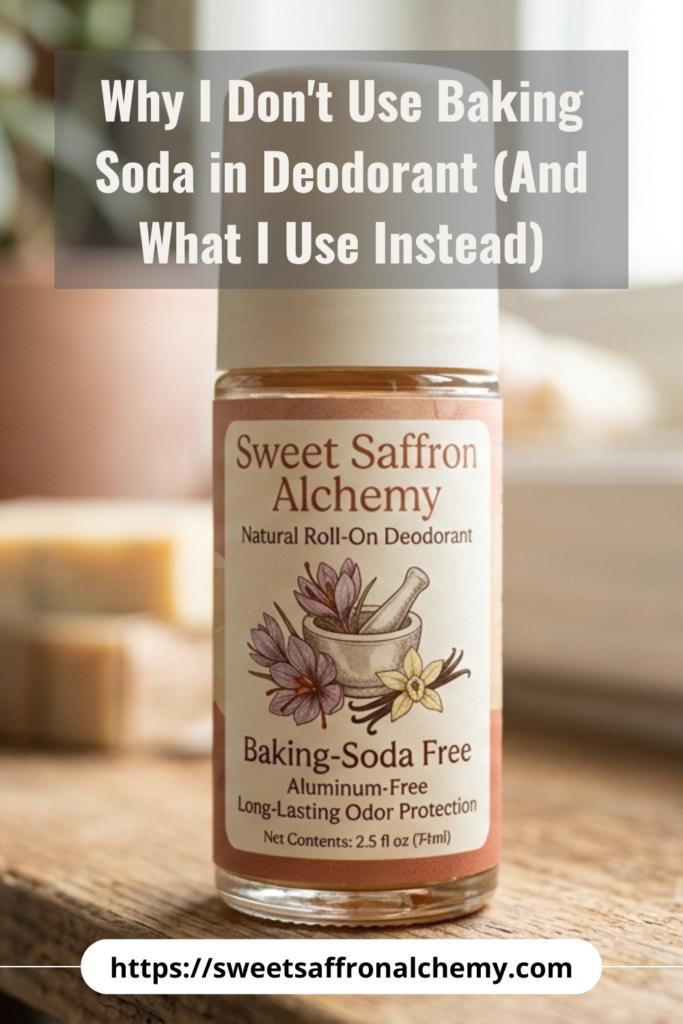
And it gets riskier when essential oils are thrown into the mix!
A lot of natural deodorant recipes add essential oils for scent, but essential oils have dermal limits — meaning there’s a maximum safe percentage before they become irritating or even sensitising to skin, and underarm skin is especially thin and absorbent.
On top of that, essential oils don’t just mix into a water or oil base on their own! They need a proper dispersing or solubilizing ingredient to be distributed safely and evenly, otherwise you end up with concentrated pockets of oil sitting directly on skin. Pair that with the pH disruption baking soda in deodorant already causes, and you’ve got two irritants compounding each other.
Essential oils also aren’t suitable for everyone — pregnant or breastfeeding mamas, young children, and people with certain skin conditions are often advised to avoid them altogether. So if your natural deodorant has both baking soda and a blend of essential oils, that combination can be genuinely risky, not just uncomfortable.
Why I Don’t Formulate With It
As a formulator, this is exactly why baking soda in deodorant doesn’t make it into my own recipes. My priority when I’m developing any product is that it works with your skin’s biology, not against it. An ingredient can be effective and still be the wrong choice if it compromises your skin barrier in the process.
I’d rather take a little longer to find odour-control ingredients that sit closer to skin-neutral pH, even if they cost more or require more careful formulating.
Halal-conscious, skin-safe, and effective shouldn’t be a trade-off — that’s the whole point of what I do.
What to Use Instead
If you’re shopping for a deodorant (or formulating your own), here are gentler alternatives to look out for on the ingredient list, in place of baking soda in deodorant:
- Magnesium Hydroxide — a much milder alkaline agent that neutralises odour without the harsh pH spike
- Zinc Ricinoleate — doesn’t mask odour like fragrance does; it actually binds to odour molecules and neutralizes them, and it’s pH-friendly
- Kaolin clay — helps absorb moisture and sweat without disrupting your skin barrier
- Arrowroot powder or tapioca starch — plant-derived, gentle absorbents that keep you feeling dry
- Probiotic or enzyme-based odour blends, which some newer natural formulas are starting to use instead of sodium bicarbonate
None of these will irritate the way baking soda does, because they aren’t fighting your skin’s natural pH just to prevent your body odour.
A Quick Checklist Before You Buy
Next time you’re eyeing a natural deodorant, ask yourself:
- Is baking soda in deodorant listed near the top of the ingredients?
- Has the brand mentioned anything about pH-balancing in their formula?
- Do they offer a version free of baking soda for sensitive skin?
If you’re unsure, patch test on your inner arm for a few days before committing your underarms to it. Your skin barrier will thank you.
At the end of the day, “natural” is a good starting point, not a finish line. The real question is always: does this ingredient respect your skin’s chemistry? For baking soda in deodorant, sadly, the answer is usually no.
Want more ingredient breakdowns like this delivered straight to your inbox? Subscribe to the Sweet Saffron Alchemy newsletter — it’s free, and you can cancel anytime.