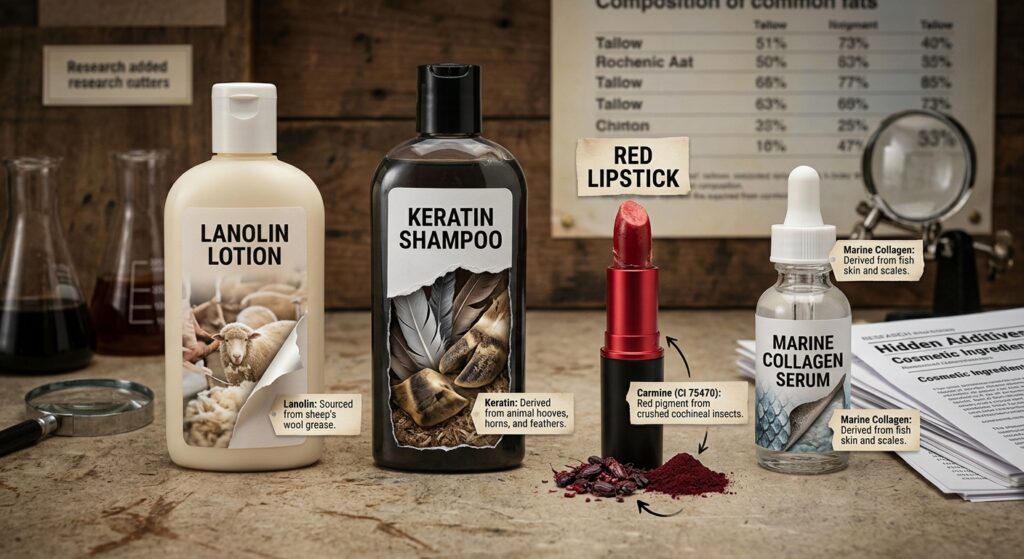
As a certified cosmetic formulator, I shall reveal the hidden animal ingredients in skincare, makeup and perfume — what they are, where they hide, and what halal alternatives to use instead.
Okay babe, remember when I told you about carmine — the crushed insect hiding in your favourite lipstick? I could hear the collective gasp across the internet. And rightfully so.
But here’s the thing. Carmine was just the beginning.
The beauty industry has been quietly slipping animal-derived ingredients into our skincare, haircare, and perfumes for decades. And unlike carmine, most of these don’t have obvious names. They sound scientific. They sound sophisticated. Some of them even sound botanical. And that is exactly the problem!
As a certified cosmetic formulator who has been working with raw ingredients since 2017, I want to give you the full picture — what these ingredients are, how they’re made, where they hide, and what beautiful, effective, halal-friendly alternatives exist. Because you deserve to know what you’re putting on your skin. Every single time.
Let’s dive deeper.
Why This Matters More Than You Think
Before we look into the list, let me say this clearly: I’m not here to make you throw your entire skincare shelf into the bin tonight. That’s not the goal. The goal is knowledge — because once you know, you can make better choices going forward, one product at a time.
And for us as Muslimahs, this isn’t just about preference. What we put on our bodies is part of our Deen. The principle of Tayyib — pure, wholesome, and good — extends beyond what we eat. It extends to everything we choose to put on the amanah of this body Allah has given us.
So let’s read those labels.
The Animal Ingredients in Skincare : One by One
✨✨✨
Collagen
What is it?
Collagen is the most abundant protein in our bodies — it’s what keeps skin firm, plump, and bouncy. As we age, our natural collagen production slows down, which is why it became such a popular skincare ingredient.
Where it comes from
Here’s the part that makes most people pause. The collagen used in cosmetics is almost always derived from animal connective tissue — specifically bovine (cow) hide and bones, or porcine (pig) skin. It is extracted by boiling these tissues down until the collagen proteins are released, then processing them into the ingredient you see on your label. Some collagen is also marine-derived, meaning it comes from fish scales and skin.
Where it hides
Anti-ageing creams, serums, face masks, sheet masks, eye creams, body lotions. Anywhere that promises “firming” or “plumping” benefits.
What to look for on the label
“Collagen,” “Hydrolysed Collagen,” “Soluble Collagen.”
Halal concern
High. Porcine collagen is haram. Bovine collagen is only permissible if the animal was slaughtered according to Islamic law — which, unless the product is halal-certified, you have no way of verifying.
Halal alternative
Marine collagen from Halal-certified fish sources, or better yet — peptides. Specifically, peptides like Matrixyl (Palmitoyl Pentapeptide) and Copper Peptides signal your skin to produce its own collagen. As a formulator, I’d take a well-formulated peptide serum over topical collagen any day. Why? Because collagen molecules are too large to penetrate the skin anyway — they sit on the surface. And peptides actually work!
✨✨✨
Elastin
What is it?
Elastin is the protein responsible for your skin’s elasticity — that snap-back quality that keeps skin looking youthful. Like collagen, our natural elastin production declines with age.
Where it comes from
Elastin in cosmetics is extracted from the connective tissue of cows, pigs, or birds — usually from the neck ligaments or aorta of the animal. It is hydrolyzed (broken down with water and enzymes or acid) to create smaller molecules for use in formulations.
Where it hides
Anti-ageing serums and creams, neck creams, firming treatments.
What to look for on the label
“Elastin,” “Hydrolyzed Elastin,” “Soluble Elastin.”
Halal concern
Same as collagen — high, depending on source. Porcine elastin is haram. Bovine requires halal slaughter verification.
Halal alternative
Plant-based stem cell extracts — from apples, grapes, and argan — have been shown to support skin’s elasticity and regenerative capacity. Also look for Bakuchiol, which supports elastin synthesis naturally.
✨✨✨
Squalene vs Squalane — The One That Trips Everyone Up
What is it?
Squalene is a lipid that occurs naturally in human sebum — it’s part of what keeps our skin naturally moisturised. As we age, squalene production drops, which is why it became a sought-after skincare ingredient. Squalane is simply the stabilised, hydrogenated form of squalene — more shelf-stable and less likely to oxidise.
Where it comes from
Originally — and still sometimes today — shark liver oil. Deep-sea sharks have livers that can make up 20% of their body weight, and those livers are exceptionally rich in squalene. It takes approximately 3,000 sharks to produce one ton of squalane. More than 60 shark species are hunted for their liver oil, 26 of which are listed as vulnerable to extinction.
Here’s the important part that most people don’t realise: both squalene AND squalane can be shark-derived. There’s a popular myth that squalene (with an “e”) always comes from sharks, while squalane (with an “a”) is always plant-based. This is not true. Both forms can come from sharks, and brands are not legally required to disclose the source on their labels.
Where it hides
Moisturizers, facial oils, serums, lip balms, sunscreens, hair oils, foundations.
What to look for on the label
“Squalene,” “Squalane.” No distinction in terms of animal origin.
Halal concern
Medium to high. Shark-derived squalane involves the killing of an animal whose slaughter method is unverified and inconsistent with Islamic requirements. Additionally, the environmental impact is significant.
Halal alternative
Plant-derived squalane exists and is excellent — sourced from olives, sugarcane, rice bran, or wheat germ. Look for the words “plant-derived,” “olive-derived,” or “vegan” on the label or brand website. Sugarcane-derived squalane is considered among the most stable and sustainable. If a brand doesn’t specify their squalane source, always assume the worst and reach out to ask.
✨✨✨
Keratin
What is it?
Keratin is the structural protein that makes up your hair, nails, and the outer layer of your skin. In beauty products, it’s marketed as a strengthening, smoothing, and repairing agent — particularly for damaged hair.
Where it comes from
The keratin used in cosmetics is extracted by boiling down animal parts — specifically hooves, horns, feathers, and hair. Chicken feathers are among the most common sources, as are wool and bovine hooves.
Where it hides
Hair masks, keratin treatments, smoothing shampoos and conditioners, nail strengtheners, some skincare.
What to look for on the label
“Keratin,” “Hydrolysed Keratin.”
Halal concern
Medium. The concern here is two-fold: the source animal and the method of processing. Keratin from pigs is haram. Keratin from other animals is mushbooh (doubtful) unless sourced from halal-slaughtered animals.
Halal alternative
Hydrolyzed wheat protein, rice protein, or soy protein — these plant-based proteins coat and strengthen the hair shaft in a very similar way to keratin. They’re widely available to formulators and increasingly found in clean beauty hair products. Oat protein is another gentle, effective option particularly well-suited for sensitive scalps.
✨✨✨
Lanolin
What is it?
Lanolin is a waxy, fatty substance secreted by the sebaceous glands of wool-bearing animals — most commonly sheep. It’s one of the most effective moisturisers known to cosmetic science, with a skin feel that closely mimics human sebum.
Where it comes from
It’s extracted from raw wool during processing — the wool is washed and the lanolin is separated from the wash water. The sheep is not killed to obtain it, but the conditions of commercial wool farming are often a source of ethical concern.
Where it hides
Lip balms, nipple creams, heel balms, baby skincare, intensive hand creams, some moisturisers. It also hides in some makeup under names like “wool wax” or “wool grease.”
What to look for on the label
“Lanolin,” “Wool Wax,” “Wool Alcohol,” “Anhydrous Lanolin,” “Lanolin Alcohol.”
Halal concern
Lower than most on this list — lanolin itself comes from a halal animal (sheep) and the sheep is not killed in the process. However, the conditions of farming and processing can vary, and some scholars advise caution due to the uncertainty around processing agents used. It is also a known allergen — if you’re sensitive to wool, you’re very likely sensitive to lanolin too.
Halal alternative
Shea butter, mango butter, and cocoa butter are all deeply occlusive, richly moisturising plant-based alternatives that perform beautifully in lip and body formulations. Candelilla wax and carnauba wax are also excellent plant-based substitutes in stick formulations.
✨✨✨
Placenta Extract
What is it?
I know. I know. But stay with me, because this one is in more products than you’d think! Placenta extract contains growth factors, amino acids, and proteins that are genuinely impressive from a formulation standpoint — they support cell regeneration and have real anti-ageing activity.
Where it comes from
Most commonly from sheep or horse placenta, collected at birth or slaughter. Some formulations — particularly from Japan and South Korea — have historically used human placenta extract, sourced from consented post-birth donations.
Where it hides
Luxury anti-ageing serums and creams. High-end Japanese and Korean skincare especially. Often marketed as “stem cell” or “regenerative” skincare without explicitly naming the source.
What to look for on the label
“Placenta Extract,” “Placental Protein,” “Placenta Hydrolysate.”
Halal concern
High. Animal-derived placenta requires halal slaughter verification. Human-derived placenta raises serious concerns around purity and dignity under Islamic ethics. Both categories are problematic without explicit halal certification. I suggest to avoid using any products with placenta in it.
Halal alternative
Plant stem cell extracts — from apple, grape, argan, and edelweiss — deliver growth factor-like activity and are widely used in clean and halal-certified formulations. Bakuchiol and niacinamide together also effectively address the regenerative and anti-ageing benefits without any animal concerns.
✨✨✨
Gelatin and Hydrolyzed Animal Protein
What is it?
Gelatin is a protein derived from collagen — specifically obtained by boiling animal skin, bones, and connective tissue. In cosmetics, it’s used as a film former, thickener, or texturizing agent.
Where it comes from
The majority of gelatin used globally is porcine — from pig bones and skin. Bovine gelatin also exists. Both require careful halal sourcing.
Where it hides
Peel-off face masks, some hair masks, nail treatments, and the capsule shells of supplement softgels. Also found as “Hydrolysed Animal Protein” in haircare where it’s used to add strength and shine.
What to look for on the label
“Gelatin,” “Hydrolysed Collagen,” “Hydrolysed Animal Protein,” or simply “Protein” in older formulations.
Halal concern
High for porcine gelatin — haram across all four madhabs. Bovine gelatin is permissible only if from halal-slaughtered animals.
Halal alternative
Carrageenan (from seaweed), agar-agar (from red algae), pectin (from fruit), and konjac are all plant-derived gelling agents that work beautifully in place of gelatin. For capsule shells, look for HPMC (hydroxypropyl methylcellulose) — plant-based and widely used in halal-certified supplements.
✨✨✨
Glycerin and Stearic Acid — The Grey Zone Duo
These two need their own special mention because they’re in almost every single cosmetic product you own — and they can be either plant-derived or animal-derived, with no way to tell from the label alone.
Glycerin is a humectant that draws moisture to the skin. It’s a byproduct of soap-making and can come from vegetable oils (coconut, palm) or from animal fat rendering. It is identical in structure regardless of source.
Stearic acid is a fatty acid used as an emulsifier, thickener, and texture agent in creams, balms, and sticks. It can be derived from plant sources like shea, coconut, or palm, or from animal tallow (rendered fat from cattle or pigs).
The problem
The label just says “Glycerin” or “Stearic Acid.” No source. No distinction.
What to do
Look for vegan certification as a proxy — this guarantees plant-derived glycerin and stearic acid. Alternatively, contact the brand directly and ask.
Reputable brands will be able to tell you.
✨✨✨
A Word on Fragrance — Perfumes Are Not Innocent Either
Let’s talk about what’s hiding in your favourite scents, babe. Because the perfume world has some of the most surprising animal-derived ingredients of all.
Musk — traditionally extracted from the musk pod of the male musk deer. To harvest it, the animal was killed and the gland removed. It is warm, animalic, and intoxicatingly complex in fragrance. The good news: genuine deer musk is now largely banned or heavily restricted globally, and the vast majority of musks in modern perfumery are synthetic. However, natural musk still appears in some niche and artisan fragrances.
Ambergris — this one is genuinely fascinating and genuinely strange. Ambergris is a waxy substance produced in the intestines of sperm whales. Fresh ambergris is dark and smells deeply unpleasant. But aged ambergris — which has spent years floating in the ocean, oxidising and transforming — develops a warm, marine, sweet, and utterly unique scent profile that perfumers have prized for centuries. It is also a fixative, meaning it helps other scent molecules last longer on the skin.
Sperm whales are an endangered species, and many countries including the US and Australia have banned ambergris. Today, most perfumers use Ambroxan — a synthetic molecule derived from clary sage that replicates ambergris’s warmth beautifully, and is halal-certified and plant-derived.
Civet — a thick, yellowish paste scraped from the anal glands of civet cats. At full concentration it smells, quite honestly, like something you’d want to run from. Diluted in a perfume, it adds an animalic warmth and depth. Civet cats were historically caged and the paste scraped at regular intervals — an inhumane practice. Most modern perfumes use synthetic civetone instead.
Castoreum — a resinous secretion from the castor sacs near a beaver’s tail, with a warm, leathery, smoky scent. Used in leather-family fragrances. Now largely replaced by synthetic alternatives.
If you’re purchasing perfume and Halal compliance matters to you, look for brands that explicitly state their musks are synthetic and their formulations are free from animal-derived fixatives. Alternatively, Attar — traditional oil-based perfume with no alcohol — from reputable Halal-certified brands is a beautiful option.
✨✨✨
How to Shop Smarter Without Was-was
You don’t need to memorize every ingredient name. Here’s what actually works:
Look for halal certification first. JAKIM, IFANCA, and ISNA are among the most credible certification bodies. A certified halal product has had its ingredient sourcing verified — you don’t have to do the detective work yourself.
Use vegan certification as a proxy. A vegan-certified product is free from all animal-derived ingredients — which covers collagen, elastin, gelatin, lanolin, carmine, and animal-sourced glycerin and stearic acid in one go. It doesn’t cover alcohol concerns, but for animal ingredients specifically, it’s a very useful shortcut.
When in doubt, ask the brand. A short, direct email to a brand’s customer service asking about the source of their glycerin, collagen, or squalane is completely reasonable.
Good brands will answer. Evasive answers are an answer too!
✨✨✨
The Best Thing You Can Do? Make It Yourself!
Here’s something I genuinely believe, and it’s the reason I became a certified cosmetic formulator in the first place: the most empowering thing you can do for your skin and your values is to know exactly what goes into your products — because you put it there yourself.
When you formulate your own skincare, you choose every single ingredient. You know where your glycerin comes from. You know your squalane is olive-derived. You know your formulation contains zero animal products or only Halal-compliant ingredients. There are no hidden surprises, no misleading labels, no need to email brands and wait for a response that may never come.
You have complete control. And as a Muslimah trying to live intentionally — that freedom is priceless.
If learning to formulate your own Halal-compliant skincare sounds like something that lights you up, stay close. That’s exactly what Sweet Saffron Alchemy is here for.
✨✨✨
A Little Thank You From Me
If you’ve read this far, I just want to say: thank you. Genuinely. It means so much that you’re here, that you care, and that you’re choosing to be more intentional about what you put on your beautiful skin.
This is exactly the kind of knowledge I wished someone had handed me years ago — and it’s why I write. If this post helped you, share it with a friend or a fellow mama who deserves to know too.
And if you want more of this — honest, science-backed, Halal-conscious beauty content delivered straight to you — join the Sweet Saffron Alchemy newsletter. It’s free, it’s full of good stuff, and you can unsubscribe any time. No hard feelings, promise. 🤍
Before you go, here’s a little something I created that you can save and refer at any time. As long as the source of the ingredient is Halal-compliant according to the supplier/manufacturer – then it is Halal. Otherwise, check to confirm.
🧴 Cosmetic Ingredients — Halal Risk Reference Table
| Ingredient | Animal Source | Found In | Halal Risk |
|---|---|---|---|
| Collagen | Bovine / Porcine / Marine | Serums, Creams, Masks | 🔴 High |
| Elastin | Bovine / Porcine | Anti-ageing serums | 🔴 High |
| Squalene / Squalane | Shark (or plant) | Oils, Moisturisers, Sunscreens | 🟠 Medium–High |
| Keratin | Chicken / Bovine / Wool | Hair masks, Treatments | 🟡 Medium |
| Lanolin | Sheep wool | Lip balms, Creams | 🟢 Low–Medium |
| Placenta Extract | Sheep / Horse / Human | Luxury anti-ageing serums | 🔴 High |
| Gelatin | Porcine / Bovine | Face masks, Supplements | 🔴 High |
| Glycerin | Animal fat or plant | Almost everything | ⚫ Check source |
| Stearic Acid | Animal tallow or plant | Creams, Sticks, Balms | ⚫ Check source |
| Musk | Musk deer (or synthetic) | Perfume | ⚫ Check source |
| Ambergris | Sperm whale (or synthetic) | Perfume | ⚫ Check source |
| Civet | Civet cat (or synthetic) | Perfume | ⚫ Check source |
Drop a comment below and tell me — which ingredient on this list surprised you the most?