Whitening Ingredients for Skin: What You Should Know Before Buying
Assalam, mamas! If you have ever stood in front of a beauty counter or scrolled TikTok Shop at 11pm wondering whether that viral “whitening” serum is worth adding to cart, this post is for you. Whitening ingredients for skin are everywhere right now!
As your resident cosmetic formulator and Halal beauty blogger, I want to walk you through the whats, whys and hows of this category so you are buying with knowledge instead of hype. Let us alchemize some clarity together.
What Are They, Exactly?
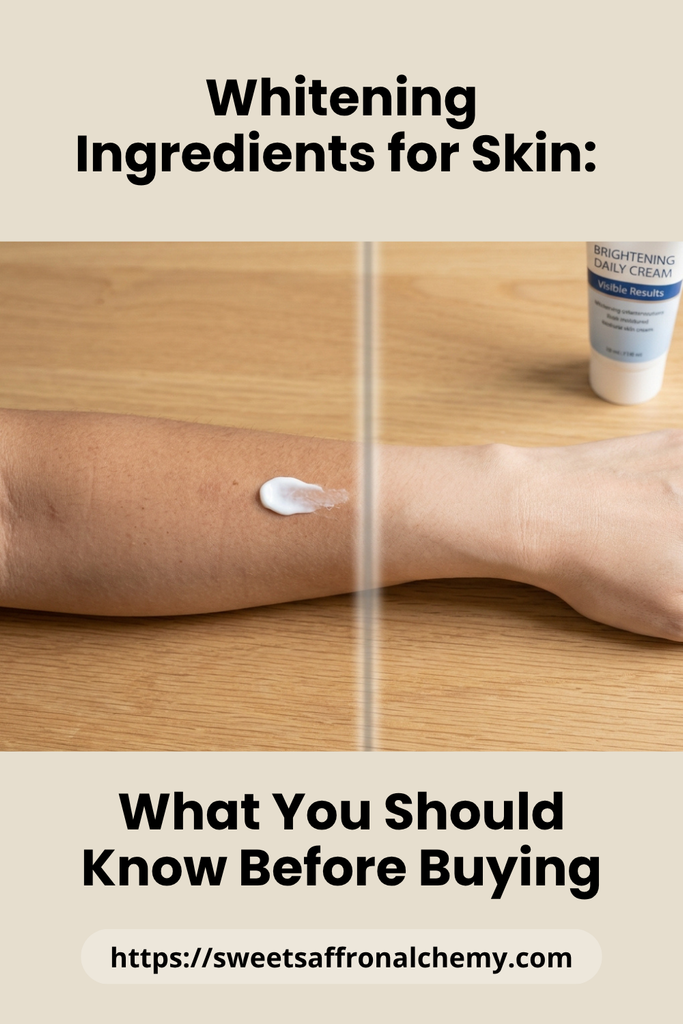
Whitening ingredients for skin are active compounds formulated to reduce the appearance of dark spots, hyperpigmentation and uneven skin tone by interrupting how our skin produces melanin. Note that this is different from “bleaching” in the harsh sense; these actives are meant to correct pigmentation, not strip your natural skin colour. Think of them as tone-correctors rather than tone-changers.
Why Do We Use Whitening Ingredients for Skin?
For most of us in our 30s and 40s, the reasons are very relatable:
- melasma from pregnancy
- dark marks left behind by acne
- sun spots from years of school runs without reapplying sunscreen
- pigmentation that creeps in with hormonal shifts
Brightening actives are used to address these concerns, restoring a more even, radiant complexion. This is not about chasing an unrealistic standard. It is about feeling comfortable and confident in your own skin.
Which Ones Are Commonly Used?
Here are some of the most common brightening actives you will encounter on an ingredient list, along with a quick honesty check on each:
- Niacinamide – Gentle, well-tolerated, and reduces the transfer of pigment to skin cells. A safe starting point for most skin types.
- Ascorbic Acid (Vitamin C) – Brightens and fights free radical damage, but can oxidize quickly and irritate sensitive skin if the concentration is too high.
- Alpha Arbutin – A derivative that mimics Hydroquinone’s action but more gentle, making it a popular, lower-risk choice.
- Kojic Acid – Effective against melasma but known to cause contact dermatitis in some users, especially with prolonged use.
- Tranexamic Acid – Increasingly popular for stubborn melasma, generally well-tolerated but still requires patience and consistency.
- Azelaic Acid – Multitasks between brightening and calming acne, suitable for sensitive and acne-prone skin.
- Licorice Root Extract (Glabridin) – A soothing, plant-derived option, gentle enough for most routines.
- Glutathione – Popular in oral and topical form, though topical efficacy is still debated among formulators.
- Hydroquinone – Highly effective but restricted to prescription use in many countries due to risks of Ochronosis with long-term, unsupervised use. Singapore included – yes, you need a doctor’s prescription for this.
- Mercury – Banned worldwide for good reason. If a product promises overnight results and has no proper labelling, mercury contamination is a real danger. Singapore included – your product will be recalled and you can be fined or jailed or both.
Who Should (and Should Not) Use Whitening Ingredients for Skin?
This is where I need you to really pay attention. These actives are not universally suitable. Pregnant and breastfeeding mothers should avoid Hydroquinone and high-dose Retinoid-adjacent brightening actives entirely.
Those with active eczema, rosacea or a compromised skin barrier should approach even gentle brightening actives with caution and always under guidance.
Teenagers with occasional post-acne marks often do not need aggressive intervention at all. Their skin usually fades marks naturally with time, sun protection and patience.
When Should You Introduce Whitening Ingredients for Skin?
Timing matters as much as choice. Many brightening actives, particularly Vitamin C and Tranexamic Acid combinations, are best introduced at night especially when you are still building tolerance.
Start with 2 to 3 applications a week rather than daily and always patch test before applying anything new to your face.
If you notice redness, stinging that does not settle or breakouts, that is your skin telling you to stop and reassess.
Where Should You Source Whitening Ingredients for Skin?
Pleaseeee only purchase whitening ingredients for skin from registered brands, licensed pharmacies or indie brands who can show you their ingredient sourcing and safety data.
In Singapore, products regulated by the Health Sciences Authority (HSA) offer a layer of protection that unregulated marketplace sellers simply cannot.
As a Halal beauty formulator, I also encourage checking whether these actives are sourced from Halal-compliant origins since some brightening ingredients are derived from Placenta or other animal-derived parts.
How Should You Use Whitening Ingredients for Skin, Safely?
Consult a Dermatologist if you have any underlying skin condition before starting.
- Patch test every single time, even with products you have used before but reformulated.
- Introduce 1 active at a time so you know exactly what your skin is reacting to.
- Pair brightening actives with a broad-spectrum SPF 30 or higher every single morning, without exception. These ingredients increase photosensitivity and skipping sunscreen can cause burning effects.
- Give it time. Most brightening actives need 4 to 6 weeks of consistent use before you see visible change. Overnight promises are a red flag, not a bonus.
Why Precaution Is Non-Negotiable
I cannot emphasize this enough: whitening ingredients for skin must always be used with precaution.
Our skin barrier is a delicate, living system, not a blank canvas to be aggressively “fixed.” Overusing these actives, layering too many at once, or applying them without sun protection can lead to a compromised barrier, increased sensitivity, rebound pigmentation that is worse than what you started with.
In extreme cases, people get chemical burns from unregulated formulations. Precaution is not optional. It is the entire foundation of safe skincare!
Why Some Cause More Problems Than Solutions
Here is an uncomfortable truth: some whitening ingredients for skin cause more problems than they solve.
This usually happens when potent actives like Mercury, Hydroquinone or Corticosteroids are added illegally to over-the-counter creams without proper labelling or dosage control, purely to deliver fast, dramatic results that keep customers hooked.
Long-term, unsupervised use of these hidden ingredients has been linked to skin thinning, visible blood vessels, steroid-induced acne and Ochronosis, a stubborn blue-black discolouration that is far harder to treat than the pigmentation it was meant to fix.
When they are misused or mislabeled, the cure genuinely becomes worse than the concern.
Popularity Does Not Equal Suitability
No matter how viral a serum goes, or how many 5-star reviews a jar of brightening actives collects online, popularity is not a substitute for compatibility.
Your best friend’s holy grail brightening cream may be your worst breakout trigger, simply because your skin type, barrier strength and sensitivity are different from hers. Before trusting a trend, always check the full ingredient list.
Sometimes you may not be sensitive to the whitening ingredients of the product but its preservatives.
Final Thoughts From Me To You
Whitening ingredients for skin can genuinely help with hyperpigmentation, melasma, and uneven tone when chosen wisely and used with patience. But they demand respect, research, and restraint, not blind trust in packaging or popularity. Go slow, patch test always, protect with SPF daily, and choose formulations that are transparent about what is really inside the bottle.
If you would like more no-fluff, ingredient-first breakdowns like this one delivered straight to your inbox, pop your email into our newsletter below. Let us keep alchemizing smarter, safer beauty choices together, 1 ingredient at a time.