Okay babe, let’s have the sunscreen talk. The real how SPF works kind of talk. Not the “just wear SPF 50 and you’re good” version — because honestly, that advice, while well-meaning, leaves out so much that actually matters.
As a certified cosmetic formulator, sunscreen is one of the topics closest to my heart — and also one of the most misunderstood in the beauty space. Most people are wearing sunscreen. Far fewer are wearing it correctly, choosing the right type, or understanding what those numbers actually mean.
By the end of this post, you’ll know exactly what SPF is, how SPF works on your skin, why your morning application isn’t lasting all day, what’s quietly killing coral reefs, and why you should never, ever try to make your own sunscreen at home.
Grab your coffee or bubble tea. Let’s get into it.
What Is SPF — Really?
SPF stands for Sun Protection Factor. It measures how well a sunscreen helps protect against UVB rays — the type of ultraviolet radiation most associated with sunburn.
Here’s the simple math: SPF 50 theoretically allows you to stay in the sun 50 times longer than you could without any protection before burning. So if your skin normally burns after 10 minutes of sun exposure, SPF 50 should protect you for about 500 minutes.
Sounds reassuring, right? But here’s what most people miss — there’s no direct relationship between your sunscreen’s number and how long you’re protected. A higher number doesn’t mean you can stay in the sun longer without reapplying. All sunscreens degrade with exposure to the sun, water, or sweat, so it’s recommended to reapply every two hours at most, regardless of which product you’re wearing.
And here’s the kicker that a lot of bloggers gloss over: sunscreen alone does not indicate protection from UVA rays — so the number on the bottle alone will not protect the skin from 95% of UV radiation. Yes, you read that right. More on that in a moment.
How SPF Works — The Science Made Simple
The sun emits different types of ultraviolet radiation. The two that reach your skin and matter for your daily life are UVA and UVB. Refer to the table below:
Type of Ray
Wavelength
Penetration
Main effects/risks
Keynotes
UVA
Long wavelength
Penetrates deep into the skin
- Ageing
- Hyperpigmentation
- DNA damage
Present all year, and passes through clouds and glass
UVB
Short wavelength
Hits the surface of the skin
- Sunburn
- Tanning
- Skin cancer risk
Strongest from 10am–4pm (based on Singapore time)
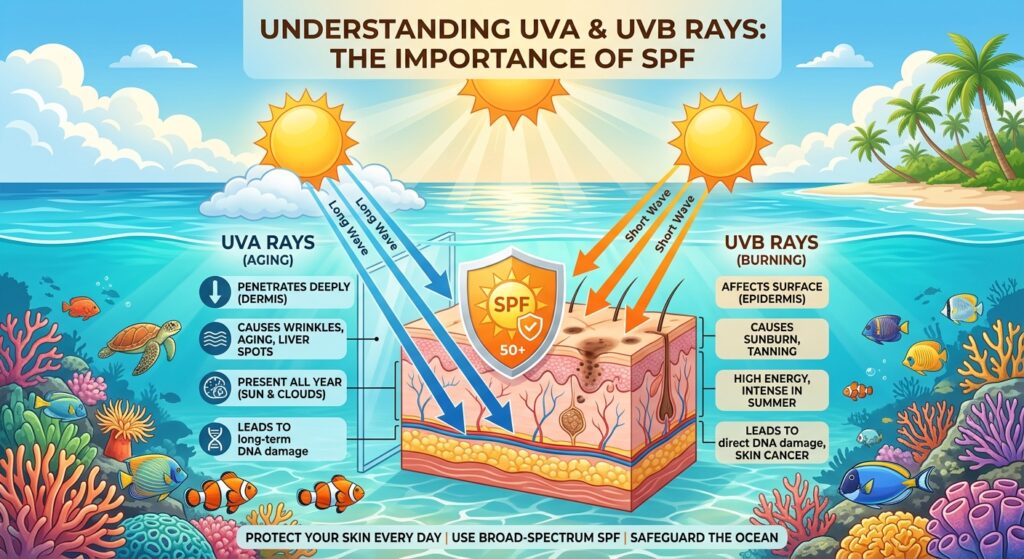
UVB rays are the ones your skin yells about. They’re the reason you come home lobster-red from a day at the beach. UVB is unable to penetrate deeper layers of the skin, so despite the prominent and painful showing of a sunburn, the damage of short-wave UVB rays remains largely on the surface.
UVA rays are the silent ones — and in many ways the more dangerous ones for long-term skin health. Long-wave UVA rays account for up to 95% of the ultraviolet radiation that reaches the Earth’s surface. They are equally intense during all daylight hours throughout the year and can penetrate glass. UVA rays cause long-term damage to deep layers of the skin, damaging elastin and collagen fibres, DNA proteins, and membranes.
This is why you can be sitting at your desk next to a window every single day and still accumulate significant UV damage without ever feeling like you’ve been “in the sun.” More than 80% of UVA rays can penetrate cloud cover, and more than 50% can penetrate glass.
That fine line forming near your eyes? The uneven tone on your cheeks? There’s a good chance UVA has been quietly contributing to both — even on days you stayed indoors!
Understanding the Numbers — What SPF 15, 30, 50 and 100 Actually Mean
This is where people get confused, so let me lay it out clearly.
The protection scale is not linear. SPF 15 blocks 93% of UVB rays, SPF 30 blocks 97%, and SPF 50 blocks 98%.
SPF 15 → blocks 93% of UVB → 7% gets through
SPF 30 → blocks 97% of UVB → 3% gets through
SPF 50 → blocks 98% of UVB → 2% gets through
SPF 100 → blocks 99% of UVB → 1% gets through
See what’s happening?
Many people assume that SPF 50 provides twice the protection of SPF 25 or SPF 30 — this is known as the diminishing returns of sunscreen numbers. In reality, going higher only offers marginally better protection.
So what about SPF 100 and above?
It exists, but it’s largely a marketing play. SPF 100 blocks 99% of UVB — just 1% more than SPF 50. That 1% matters for very fair skin or people with medical photosensitivity, but for most of us, SPF 30, correctly and consistently applied, is sufficient. The more important variable isn’t the number — it’s how you apply it and how often you reapply.
What About the PA Rating? (This One’s for Us – SG Girls)
If you shop Asian skincare brands — Korean, Japanese, or local — you’ve seen this: PA+, PA+++, PA++++. And probably wondered what on earth it means! Chill…
The PA rating is the Asian standard for measuring UVA protection. It stands for Protection Grade of UVA, and it works like this:
PA+ → Some UVA protection
PA++ → Moderate UVA protection
PA+++ → High UVA protection
PA++++ → Extremely high UVA protection
Western sunscreens use the term “broad spectrum” to indicate UVA coverage, but they don’t specify how much UVA protection you’re getting. The PA system — developed in Japan — fills that gap. For daily use, especially in a year-round sunny climate, you want at minimum PA+++, and ideally PA++++.
My recommendation? Look for both. A sunscreen that says SPF 50 PA++++ is covering you properly for both types of UV rays.
One Application Is Not Enough. Here’s Why.
This is possibly the most important thing in this entire post, and I want you to really hear it.
Applying sunscreen in the morning does not protect you for the full day. Full stop.
All sunscreens degrade with exposure to the sun, water, or sweat. Even without swimming or sweating, UV exposure itself breaks down the protective filters in your formula. Reapplication every two hours is recommended no matter which product you use.
But there’s more. The number on the bottle assumes a generous application of the product. In real life, many people apply less, achieving far less effective coverage than promised.
How much is enough?
Laboratory testing uses about 2 milligrams per square centimetre of skin. For context, for your face alone that’s roughly half a teaspoon. Most people apply a quarter of that. Which means your SPF 50 may actually be performing more like a measly 10 on your skin.
The rule I follow — and what I’d recommend to you:
- Apply generously — don’t be stingy. That’s why many brands now carry the kind that doesn’t have “white cast”
- Apply 15–20 minutes before sun exposure so it has time to bond with your skin
- Reapply every 2 hours when outdoors
- Reapply immediately after swimming or heavy sweating — even if the label says water-resistant
Speaking of which…
Waterproof vs. Water-Resistant: What’s the Difference?
Let’s clear something up: there is no such thing as waterproof sunscreen. None. Nada. How SPF works if it’s waterproof?
Regulatory bodies around the world have actually banned the use of the term “waterproof” on sunscreen labels because it’s misleading. What you will see is “water-resistant” — and even then, it has a time limit.
Water-resistant formulas maintain their effectiveness for a certain period when in contact with water or sweat. All liquid sunscreens start to gradually lose effectiveness after the first contact with water. Labels will specify either 40 minutes or 80 minutes of water resistance — after that, it needs to be reapplied.
So yes — even your water-resistant formula needs to come back out of your beach bag after every swim.
Kids’ Sunscreen vs. Adults’ Sunscreen — Are They Actually Different?
Short answer: yes, and the differences matter.
Kids’ sunscreen is formulated specifically for children’s thinner, more permeable, and more reactive skin. Key differences:
Mineral-only filters — most paediatricians recommend that children use sunscreens with only zinc oxide or titanium dioxide as active ingredients, as these sit on top of the skin rather than being absorbed. Chemical filters are generally not recommended for young children.
Fragrance-free — fragrance is one of the most common causes of contact dermatitis in children.
Gentler base formulas — fewer potential irritants, often soothing ingredients like aloe vera or calendula.
Higher SPF — children’s sun tolerance is lower; SPF 50+ is standard for kids.
Adults’ sunscreen tends to have more formulation flexibility — including chemical UV filters, actives like niacinamide or hyaluronic acid, and tinted or cosmetically elegant textures. These are fine for adult skin but not appropriate for babies or young children.
A practical note: if your child has very sensitive skin, a mineral kids’ formula is actually a great option for sensitive adult skin too. The gentleness works in your favour.
What Form of Sunscreen Should You Use? Lotions, Serums, Sticks and More
Walk into any pharmacy or beauty counter and you’ll quickly realize that sunscreen isn’t just one thing anymore. The format you choose matters — not just for convenience, but for how well it actually protects you. Here’s a breakdown of what’s out there:
Lotion is the classic. It’s the most widely available, easiest to apply in generous amounts, and spreads evenly across large areas like the face, neck, arms, and body. If you’re new to sunscreen or looking for something straightforward, a lotion is your most reliable starting point. The texture tends to be lightweight to medium, and most daily-use facial sunscreens come in this format.
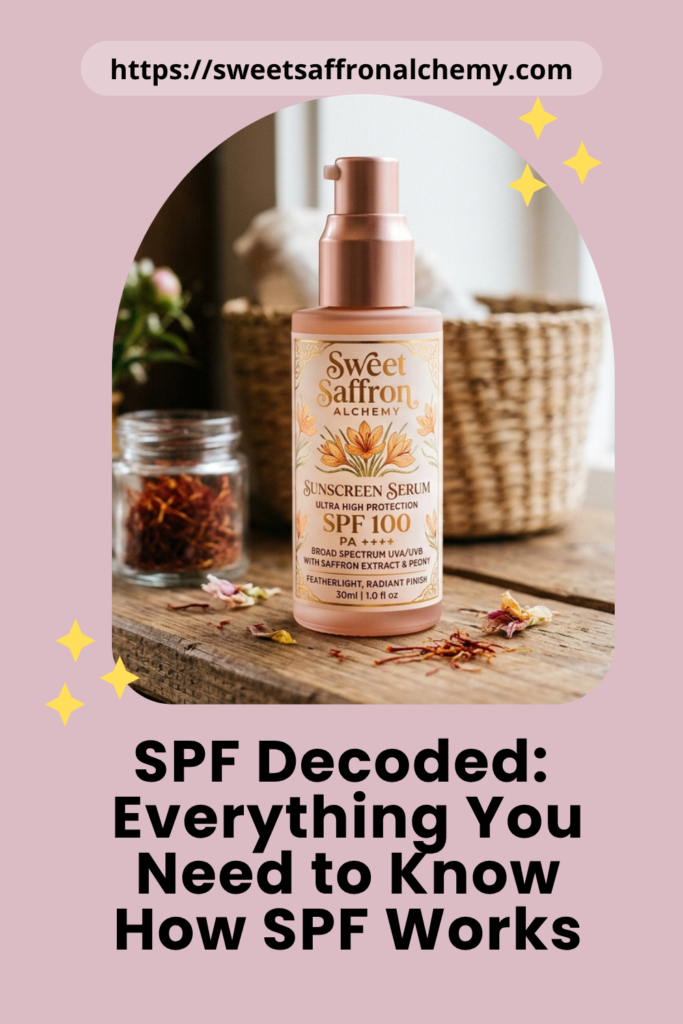
Serum sunscreen is a newer, more cosmetically elegant format — thinner in consistency, fast-absorbing, and often layered with skincare actives like niacinamide, hyaluronic acid, or antioxidants. If you love a lightweight feel and want your sun protection to double as a skincare step, this is a great option. Just watch the application amount — because serums spread so easily, people tend to use less than needed.
Stick sunscreen is brilliant for targeted areas — the nose, ears, around the eyes, and hairline — places that are easy to miss with a lotion. It’s also incredibly convenient for reapplication on the go, especially for mamas chasing kids around outdoors. Toss it in your bag and you have no excuse not to reapply. Note though: sticks are harder to apply generously enough for full-face coverage on their own, so use them as a complement to lotion, not a replacement.
Balm sunscreen is similar to sticks but usually richer and more emollient — great for dry skin types or for lip protection. Yes, your lips need sunscreen too, babe. UV exposure affects lip skin just as much as the rest of your face.
Spray sunscreen is popular especially for children and body coverage, but it comes with caveats. Sprays are notoriously difficult to apply evenly, and the amount that actually lands on the skin is often far less than needed. If you do use a spray, spray liberally and rub it in — don’t just mist and walk away. Also avoid spraying directly on the face; spray into your hands first and then apply.
Powder/setting powder with SPF — let me be straight with you here as a formulator: these are not reliable as your primary sun protection. The amount of powder needed to reach the stated SPF is far more than anyone would realistically apply. Use them for reapplication top-ups over makeup, not as a standalone shield.
Tinted sunscreen deserves a special mention — it combines a light coverage with sun protection, making it a wonderful all-in-one for mamas who want a fuss-free morning routine. Many tinted formulas also contain iron oxides, which provide an added layer of protection against visible light and blue light. A win all around.
Whatever format you choose, the golden rule stays the same: apply enough, apply it properly, and reapply. The best sunscreen format is the one you’ll actually use consistently.
The Reef Crisis — And Why Your Sunscreen Choice Matters
I need to pause here, because this section isn’t just about your skin. It’s about something much bigger. And I feel strongly that we talk about this — loudly, and often.
Currently, an estimated 8,000 to 16,000 tons of sunscreen enter coral reefs each year. When we swim, shower, or wade in the ocean, the chemical UV filters in conventional sunscreen wash off our bodies and into the water. And what happens there is devastating.
The chemicals that shield us — such as oxybenzone, octinoxate, and octocrylene — are toxic to coral reefs. They cause coral bleaching, DNA damage, and disrupt fish reproduction, all stressors that fragile reef ecosystems cannot afford.
The numbers are catastrophic. From just 21% of reefs affected in 1998, bleaching-level heat stress increased to 84% of reefs globally by early 2025.
84%. Nearly all of the world’s coral reefs are under severe stress right now.
The CDC found that over 90% of the 2,500 people tested had oxybenzone in their urine. These chemicals have also been found in breast milk. This isn’t just an ocean problem — it’s a human health problem too. The FDA recently proposed removing all over-the-counter chemical sunscreen ingredients including avobenzone, oxybenzone, octisalate, and homosalate from their Generally Recognised as Safe and Effective list due to potential adverse human health impacts and a lack of sufficient safety data.
In 2018, Hawaii passed the first ever statewide ban on oxybenzone and octinoxate sunscreens. Island nations including Palau, Bonaire, and Aruba have since followed.
We don’t live near the Great Barrier Reef. But we live near coral systems too — and we travel. Every time any of us steps into the ocean wearing a chemical sunscreen, we’re contributing to this. I’m not here to make you feel guilty, but I am here to tell you the truth: the choice of sunscreen you make matters beyond your skin.
What should you look for?
A reef-friendly formula will only contain the minerals zinc oxide and/or titanium dioxide as active ingredients. The terms “reef friendly” and “reef safe” are not regulated — any brand can use those terms even if the ingredients tell a different story. The best and only way to know for sure is to read the label carefully.
Also check for non-nano on the label.
Versions made with nanoparticles — particles smaller than 100 nanometers — may still pose risks to marine life. Choosing non-nano mineral sunscreens is a safer option for the ocean.
A Note for Our Muslimahs: Sunscreen and Wudhu
This is something I get asked about a lot — and I want to address it properly, because as a formulator + a Muslimah myself, it sits right at the intersection of skincare and ibadah.
Here’s the thing about sunscreen that most people don’t realize: sunscreen — especially mineral and water-resistant formulas — works by forming a protective film on the skin’s surface. That’s literally the mechanism. The UV filters either absorb into the upper layers of the skin or sit on top of it to deflect and scatter UV rays. Either way, something is sitting between your skin and the outside world.
And that raises a valid question before wudhu: is water actually reaching my skin?
Scholars have different positions on this, and I won’t go into a deep Fiqh discussion here. What I can tell you from a formulation standpoint is this: not all sunscreens behave the same way on the skin. A lightweight chemical sunscreen that fully absorbs and leaves no trace? Very different from a thick mineral SPF 50 stick that leaves a visible white cast on the skin. One leaves a film you can see and feel. The other doesn’t.
So here’s my practical guidance as both a formulator + Muslimah:
If you fully understand the formula you’re using — you know it’s a lightweight, fully-absorbed chemical sunscreen that leaves absolutely no residue — and you’re confident water is reaching your skin freely during wudhu, then scholars have indicated your wudhu may well be valid.
But if you’re not sure — if you can’t tell whether your sunscreen has fully absorbed, if it’s a heavier mineral formula, if there’s any doubt at all — then the safest, most peace-of-mind approach is to wash it off properly before wudhu. Remove it completely with a cleanser (facial wash and/or body wash) then make your wudhu fresh. This is a precaution and there is nothing wrong with choosing it. It is better to do this than to create unnecessary was-was (doubt). In this case, the peace of mind is worth a lot.
You can always reapply your sunscreen + makeup after prayers. Never miss your prayers babe. That glow on your face – you can only get it thru prayers.
A gentle foaming or micellar cleanser is usually enough to remove most sunscreen formulas. For heavier mineral or water-resistant sunscreens, a cleansing balm or oil cleanser as a first step, followed by your regular facial wash, will ensure a thorough clean without compromising your skin. This is what formulators call double cleansing — and for Muslimahs wearing sunscreen daily, it’s genuinely a game-changer!
Please — Do Not Make Your Own Sunscreen at Home
I know this community loves a good DIY. And I am all for formulating your own serums, balms, deodorants — I do it myself and I teach it. But sunscreen? Absolutely not. And I say this as a certified formulator with years of experience.
Homemade sunscreens will not have a verified, tested protection rating and will not have undergone the required, expensive, and extensive clinical testing to determine their efficacy, safety, or stability.
A study analyzed 15 DIY sunscreen recipes found online. Three of the recipes contained no UV-filtering ingredients whatsoever. The other 12 tested below a protection level of 6 — well below the minimum threshold required in Europe, and far below what’s needed for real sun protection.
Here’s why even well-intentioned DIY sunscreen fails:
You can’t disperse zinc oxide evenly without industrial equipment. Commercial mineral sunscreens are mixed with specialised machinery that ensures the minerals are evenly and smoothly dispersed down to a microscopic level. Without this, the minerals clump in ways that may not be visible to the eye but result in inconsistent protection. Your kitchen blender cannot do this.
You cannot verify the protection level without third-party lab testing. Third-party testing costs thousands of dollars per sample. Without it, that “SPF 30” label might actually be delivering a 5 — or nothing at all.
Coconut oil is not sunscreen. Coconut oil has been tested at a protection level of around 1. A 2010 study found that most natural oils have very low UV protection levels, well below what is recommended. Many popular DIY recipes online claim much higher protection than testing has ever shown.
Essential oils can make things worse. Essential oils commonly found in DIY recipes can be phototoxic — meaning they can cause skin reactions when exposed to sunlight. You could end up with chemical burns on top of sun damage.
Sun protection is one area where “natural and homemade” is genuinely dangerous. Leave sunscreen formulation to the specialists with the equipment, the regulatory knowledge, and the testing infrastructure to do it safely. Your skin — and your family’s skin — deserves that certainty.
Eat Your Sunscreen? The Power of UV-Protective Superfoods
Here’s something that will genuinely delight you — there are foods that support your skin’s natural resilience against UV damage from the inside out. These don’t replace your sunscreen. Nothing does but they work alongside it beautifully.
Tomatoes (Lycopene): Research demonstrates that simply eating tomato paste daily for ten weeks reduced sunburn by a whopping 40%. Lycopene is the red antioxidant in tomatoes, and it accumulates in the skin where it helps neutralise UV-triggered free radicals. Bonus: the body can more easily absorb lycopene when tomatoes are cooked, especially in olive oil. So your next bowl of pasta with tomato sauce is practically a wellness ritual.
Astaxanthin: Among the most potent of the carotenoid antioxidants, astaxanthin has been heralded as an “internal sunscreen.” Studies suggest it reduces sun-induced skin damage, skin wrinkling, and loss of skin elasticity. It’s found naturally in salmon, shrimp, and krill — and available as a supplement. Consider 2–4mg of astaxanthin daily to improve your skin’s resilience to sun exposure.
Watermelon (also Lycopene): Watermelons actually contain far more lycopene than tomatoes. Lycopene absorbs UVB radiation.
Omega-3s (Walnuts, Chia, Fatty Fish): Omega-3s help maintain your skin’s integrity and are anti-inflammatory, helping your body naturally cope with the effects of spending time in the sun.
Green Tea: Rich in polyphenols and flavonoids that combat UV-triggered oxidative stress and help protect your skin’s collagen.
Understanding how SPF works is only half the picture — the other half is what you put in your body. Think of these superfoods as your internal protection team. They don’t block rays — but they significantly improve your skin’s ability to handle and recover from UV exposure. Build them into your diet consistently and your skin will thank you.
You can try Project B UV White, a product that has Extended Release Proprietary Formula with double performance, better efficacy and longer lasting Effect.
Reef-Friendly Sunscreen Brands Worth Knowing
Badger Balm SPF 30 (Global, available online) — Organic and reef-safe, made with non-nano zinc oxide and beeswax for staying power. Gentle on skin, strong on eco-credentials. A certified B Corporation with an impressively minimal ingredient list.
Thinksport SPF 50 (Global, available online) — Non-nano zinc oxide with vitamin E — water-resistant and eco-friendly. One of the top-rated reef-safe picks, Hawaii-compliant, and widely available through international online retailers.
Stream2Sea SPF 35 (Global, available online) — Active ingredient is non-nano titanium dioxide, paired with green tea, tulsi leaf, seaweed, aloe, and coconut oil. Biodegradable, paraben-free, and water-resistant up to 80 minutes. Great for beach days.
Of course, there are other brands not mentioned here. You are free to use any brands that you prefer.
When shopping, flip the bottle. The active ingredients should say only zinc oxide and/or titanium dioxide, with the words non-nano either on the label or confirmed on the brand’s website. If you see oxybenzone, octinoxate, octocrylene, or avobenzone in the active ingredients — put it back.
The Formulator’s Sunscreen Checklist
Before I end the post — here’s your quick reference for choosing and using sunscreen correctly:
✅ Broad spectrum — covers both UVA and UVB
✅ Minimum protection factor of 30 for daily use; 50 for extended outdoor time
✅ PA+++ or PA++++ if you’re shopping Asian brands
✅ Apply generously — half a teaspoon for the face alone
✅ Apply 15–20 minutes before going out
✅ Reapply every 2 hours — non-negotiable
✅ Reapply after swimming or sweating even with water-resistant formula
✅ Non-nano mineral formula if you’ll be near the ocean
✅ Kids get mineral-only, fragrance-free formulas
✅ Never DIY your sun protection formula
✅ Support from within — lycopene, astaxanthin, omega-3s
Sun protection isn’t just a step in your skincare routine. It’s a daily act of care — for your skin, for your family, and honestly, for the world we share.
Did anything in this post change how you’ll use your sunscreen going forward? Drop it in the comments, I’d love to hear from you!