Are you using natural deodorant? When was the last time you actually read the label on your deodorant?
Most of us have been reaching for the same stick, roll-on or spray since forever — out of habit, out of loyalty, or honestly because we’re just grateful it gets us through the day without embarrassment.
But as a certified cosmetic formulator who has been creating deodorant products since 2017, I want to have a proper honest conversation about what’s actually in your deodorant, how it works, and why some popular natural alternatives — especially the baking soda ones — might be doing your skin more harm than good.
Let’s get into it.
Deodorant vs Antiperspirant — They’re Not the Same Thing
This surprises a lot of people, but deodorant and antiperspirant are fundamentally different products doing very different jobs.
Antiperspirant works by temporarily blocking your sweat glands — usually with aluminium salts like aluminium chlorohydrate or aluminium zirconium. Less sweat reaches the skin surface, which means less odour. It’s targeting the source.
Deodorant does not stop you from sweating. What it does is neutralize or mask the odour after sweat hits the skin surface — usually through antibacterial agents, odour-absorbing ingredients or fragrance.
Here’s the thing: sweat itself is actually odourless. The smell comes from bacteria on your skin breaking down the compounds in sweat. So a good deodorant’s real job is to manage those bacteria and neutralize what they produce — not to pretend sweating isn’t happening.
This matters because a lot of women switch to “natural deodorant” expecting antiperspirant-level dryness and then give up when they still sweat. That’s not the product failing — that’s just how your body is supposed to work.
Sweating is a natural, necessary process.
What you actually want is to stay fresh, not to be completely dry.
So Why Do So Many Natural Deodorants Use Baking Soda?
Walk into any natural or “clean beauty” space and you’ll find baking soda (sodium bicarbonate) everywhere in deodorant formulas. DIY recipes, indie brands, health food store finds — it’s one of the most popular natural deodorant ingredients out there!
And from a basic chemistry standpoint, it makes sense. Baking soda is alkaline, and odour-causing bacteria thrive in a more acidic, sweaty environment. By raising the pH, baking soda creates conditions where those bacteria struggle to survive. Odour-control achieved — but only in theory.
And here’s where it gets complicated. And this is me talking to you as a formulator, not just as a blogger.
Why Baking Soda Deodorants Are Problematic — A Formulator’s Take
Your underarm skin has a natural pH of around 4.5 to 5.5 — mildly acidic. This acidity is not a flaw. It’s a protective feature. That slightly acidic environment — called your acid mantle — acts as your skin’s first line of defense against bacteria, environmental irritants, and moisture loss.
Baking soda has a pH of 8 to 9.5.
When baking soda is applied to the skin, it shifts the underarm’s chemistry significantly — creating an alkaline environment that disrupts the skin’s natural balance. And unlike magnesium hydroxide (a gentler alkaline alternative), dissolved sodium bicarbonate immediately floods the skin surface with that pH change rather than releasing it gradually.
What does this mean in practice?
The skin barrier gets disrupted, good and bad bacteria on your skin shift, skin gets dry, tight, and more reactive, and redness, bumps, and stinging can show up — sometimes even after weeks of no issues.
Dermatologists now routinely flag sodium bicarbonate as a likely culprit when patients present with underarm contact dermatitis after switching to a “natural” product.
The tricky part?
This irritation can appear after just one use — or after months of using a product that had been fine. Changes in body chemistry, caused by hormonal shifts, can also cause a deodorant that used to work fine to suddenly cause reactions.
So if you’ve ever tried a natural deodorant and ended up with red, itchy, darkened, or bumpy underarms — it was almost certainly the baking soda. Not your skin being “dramatic.” The formula being wrong.
Signs your deodorant may be causing baking soda irritation:
- Red, hot patches where you apply it
- Burning or stinging that starts soon after use
- Dry, flaky skin that feels tight or itchy
- Small bumps or rough texture in the armpit area
- Gradual darkening of the underarm skin with continued use
If any of these sound familiar, stop using it immediately and give your skin a few days to recover with just a gentle, pH-balanced cleanser on the area. If the problem doesn’t go away, seek medical help as soon as possible.
What Should a Good Natural Deodorant Actually Contain?
This is where formulation knowledge really matters. There are effective, skin-friendly odour-fighting alternatives to baking soda that work with your skin’s natural pH instead of against it.
Magnesium hydroxide is one of the best. It controls odour through a similar mechanism to baking soda — creating an environment less favourable for odour-causing bacteria — but its low solubility means it doesn’t immediately spike the skin’s pH. It works as a slow-release antibacterial effect, a gradual and sustained modulation rather than an immediate harsh shift.
Zinc compounds — like zinc ricinoleate or zinc oxide — offer antimicrobial properties and can effectively support odour control without disrupting the skin barrier.
Arrowroot powder or tapioca starch absorb moisture beautifully, keeping the underarm area dry and less hospitable to odour-causing bacteria — all while being completely gentle on skin.
Plant-derived antimicrobials — certain botanical extracts, essential oils, and ferment-based ingredients — can target odour at the bacterial level without a harsh pH shift. (Do not apply essential oils directly on your skin!)
A well-formulated natural deodorant combines several of these thoughtfully, at the right concentrations, and in a base that also nourishes the delicate underarm skin rather than stripping it.
The “Detox” Period — Is It Real?
You may have heard that switching to natural deodorant comes with a “detox period” — a few weeks of increased sweating or odour while your body adjusts. Some of this is real, and some of it is a myth.
What is real: if you’ve been using antiperspirant for years, your sweat glands have been partially blocked. When you stop, they normalize — and that can temporarily feel like more sweat than usual. Your skin’s microbiome also shifts as the aluminium salts leave your system, and this adjustment period can temporarily affect odour.
What is not real: suffering through rashes, burns, or irritation is not part of any healthy detox process. That is a skin reaction to an incompatible formula. Discomfort is not something you should push through — it’s something you should listen to.
Give your body 1-2 weeks to adjust to natural deodorant. If you’re still experiencing irritation after the first few days, the formula is the problem, not you.
What I Look for When I Formulate a Deodorant
Having formulated my own deodorant since 2017 — one that became a bestseller — these are the non-negotiables I work to:
- pH-conscious formulation. Strictly no baking soda. The formula must respect the skin’s acid mantle, not override it.
- Effective odour neutralization without masking. I want the formula to actually address bacteria, not just cover the smell with fragrance.
- Skin nourishment built in. Underarm skin is thin and delicate. A good deodorant should leave it soft, not dry.
- Halal-compliant, cruelty-free ingredients, alcohol-free. Non-negotiable for my brand and my community.
- Stable in warm, humid conditions. Because a formula that separates in tropical heat is a fail formula.
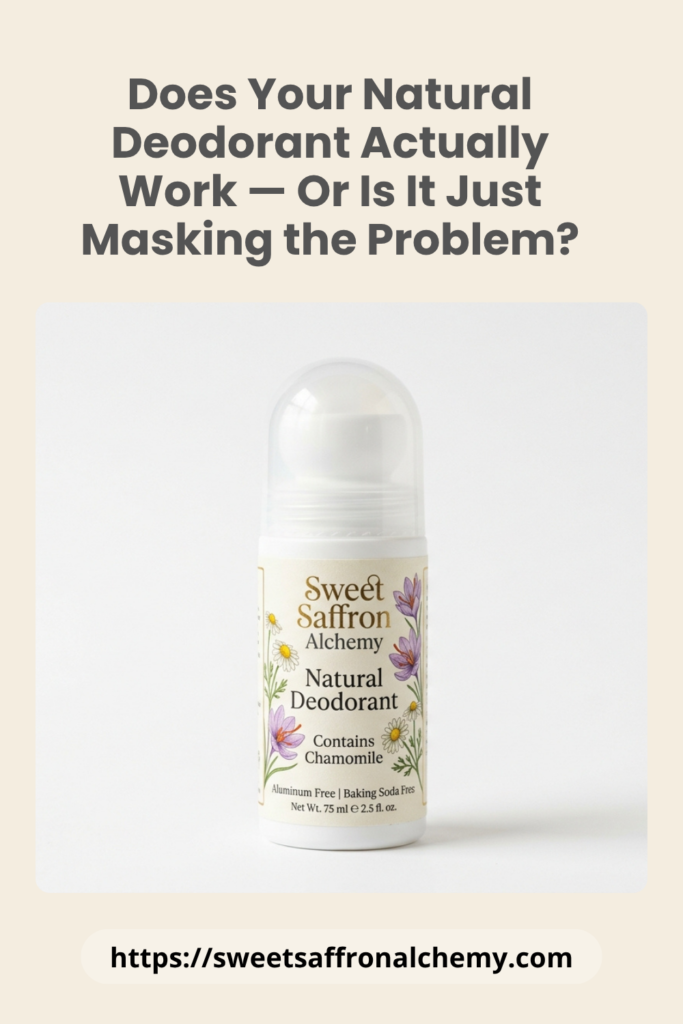
Explore the Sweet Saffron Alchemy Deodorant
I’ve been formulating my signature deodorant for years, and I’m currently working on sharing the full details of the formula — the ingredients, the philosophy behind each one, and exactly how it was designed to work for us.
If you want to be the first to know when it’s available — ingredients breakdown, how-to-use guide and all — make sure you’re subscribed to the Sweet Saffron Alchemy newsletter.
I’ll be sharing everything there first, including a behind-the-scenes look at what goes into formulating a deodorant that actually works without compromising your skin or your values.
You deserve a product that is made with intention. Not just one that masks the problem.
Have you had a bad experience with a natural deodorant before? I’d genuinely love to hear about it in the comments — and if you have questions about ingredients or what to look for, drop them below.