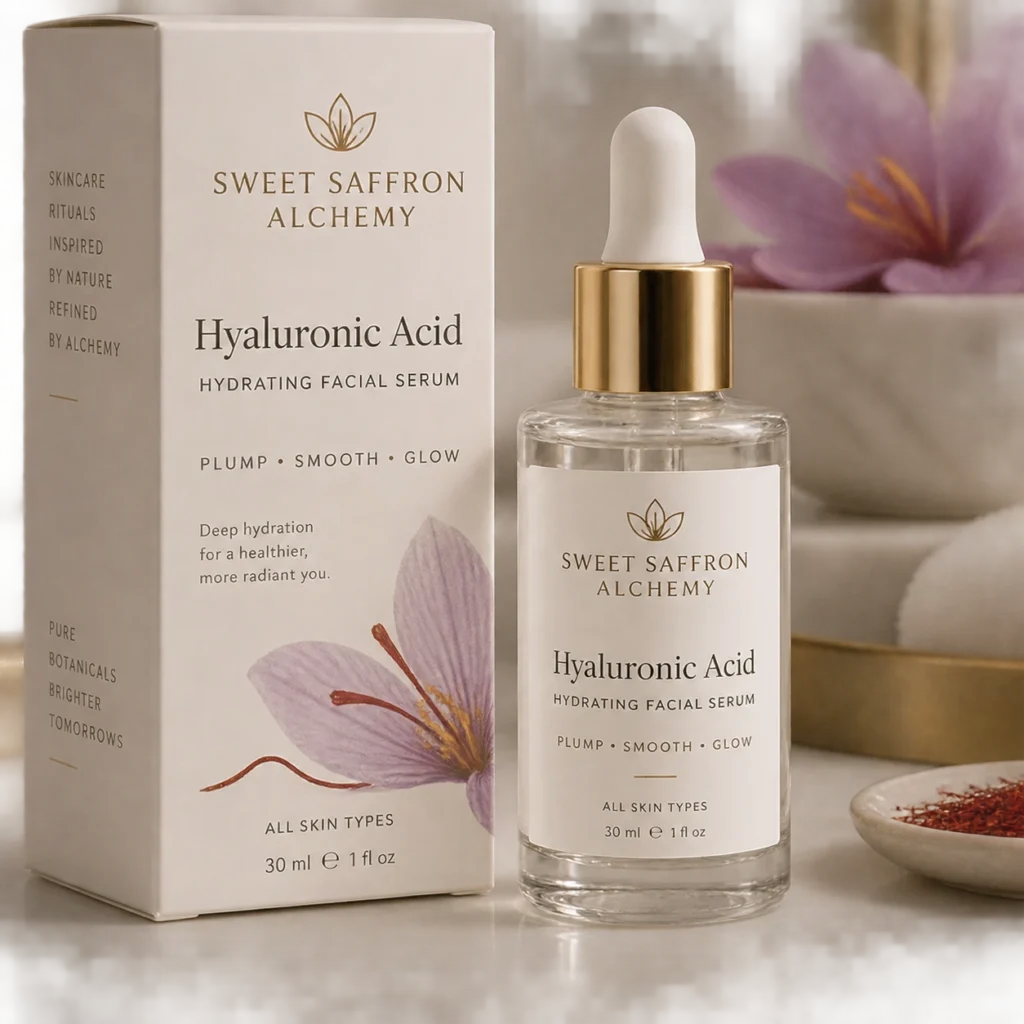
Hey babe, let me guess. Someone told you that Hyaluronic Acid is the holy grail of hydration, so you bought the serum, patted it on every morning and still ended up with tight, thirsty skin by lunchtime. Sound familiar?
You are not imagining it. Hyaluronic Acid is a brilliant ingredient, but it’s also among the most misunderstood ingredients in skincare. Used the right way it helps skin feel plump, soft and comfortable. Used the wrong way (on bone-dry skin, in a dry air-conditioned room, with no moisturizer to seal it in) it can leave your face feeling even drier than before you started.
I have been formulating cosmetics since 2017, and “I use hyaluronic acid every day but my skin is still dry” is a very common complaint among mamas.
In this guide I will break down what hyaluronic acid really is, how molecular weights and humidity change the way it behaves, what the big brands do not always tell you, who should be careful and how to buy and apply it properly. Grab your Teh Tarik and let’s get into it.
Hyaluronic Acid in a Nutshell: The Whats, Why and Hows
What is it?
Hyaluronic Acid (often shortened to HA) is a sugar-based molecule that binds water. On labels you will see it as Hyaluronic Acid or Sodium Hyaluronate.
HA is a natural substance found in your body, especially in your skin, joints and eyes. Around 50% of the Hyaluronic Acid in your body sits in the skin, where it acts like a cushion and a water reservoir between your cells.
As we age (and as we spend more time in the sun) our natural levels of Hyaluronic Acid drop. This is a big reason skin starts to feel drier and look less bouncy.
The INCI Name of Hyaluronic Acid
INCI stands for International Nomenclature of Cosmetic Ingredients. It is the standard naming system you will find on the back of every skincare product. Hyaluronic Acid appears on labels in several forms:
- Hyaluronic Acid: the pure acid form.
- Sodium Hyaluronate: the salt form of Hyaluronic Acid. It is the most common version in skincare because it is more stable and dissolves easily in water.
- Hydrolyzed Hyaluronic Acid: Hyaluronic Acid that has been broken into smaller pieces (INCI uses the “z” spelling). Smaller pieces can sink into the upper layers of the skin more easily.
- Sodium Hyaluronate Crosspolymer: a cross-linked form that clings to the skin surface for longer.
When a brand says “contains Hyaluronic Acid” it very often means Sodium Hyaluronate. They behave in a similar way on the skin so this is not a trick. It is just chemistry.
Why use it?
It is a humectant which means it attracts water and helps skin feel hydrated and bouncy.
When to use it?
Morning and/or night.
Where can you find it?
In serums, essences, toners, moisturizers, sheet masks and eye creams. In your body it lives mostly in the skin, joints and eyes.
Who can use it?
Most skin types can enjoy it but a few people need to take extra care.
How to use it?
Apply it on damp skin and seal it in with a moisturizer.
The Chemical Formula of Hyaluronic Acid
Hyaluronic Acid is a long chain (a polymer) so its formula is written as a repeating unit. The unit is C14H21NO11 and it repeats thousands of times, so we write it as (C14H21NO11)n. Sodium Hyaluronate is written as (C14H20NNaO11)n.
What Is Hyaluronic Acid Made Of?
Hyaluronic Acid is built from 2 sugar-type building blocks that take turns along the chain: D-Glucuronic Acid and N-Acetylglucosamine.
Imagine a very long necklace with 2 alternating types of bead. Each bead has lots of tiny spots that grab onto water molecules. That is the reason HA is so good at holding water.
Where Does Cosmetic Hyaluronic Acid Come From?
In the early days HA was extracted from rooster combs. Cock-a-doodle-doo!
Today most Hyaluronic Acid in skincare is made by bacterial fermentation. Bacteria are fed sugars and they produce HA as a by-product. It is then purified and the bacteria are removed. Strains used include Streptococcus equi subsp. zooepidemicus and Bacillus subtilis.
Fermentation is cleaner and more consistent and it does not rely on animal tissue (more on the Halal side of this below).
Why Is Hyaluronic Acid Such a Big Deal?
You have probably seen the claim that HA can hold up to 1,000 times its weight in water. That figure comes from lab testing of the ingredient in water. It is a real property but it does not mean your face will hold 1,000 times anything.
On your skin Hyaluronic Acid sits mostly in the top layers (the stratum corneum). There it gives a temporary plumping and softening effect and helps reduce water loss from the surface.
What HA does well:
- Helps skin feel hydrated and smooth within minutes
- Softens the look of fine dehydration lines
- Is lightweight and non-greasy so it suits oily skin too
What HA does not do:
- it does not erase deep wrinkles
- it does not rebuild collagen on its own
It is a hydrator and not a miracle!
Molecular Weights of Hyaluronic Acid Explained
This is where formulators get excited. The size of a Hyaluronic Acid molecule is measured in kilodaltons (kDa). Size matters because it changes how the ingredient behaves on your skin. The ranges below vary slightly between suppliers but this is the general idea:
High molecular weight (above 1,000 kDa): these big molecules stay on the surface and form a thin, breathable film. They reduce water loss and give that smooth, silky feel. They do not sink in.
Medium molecular weight (around 100 to 1,000 kDa): these hydrate the upper layers of the stratum corneum.
Low molecular weight (below 100 kDa): smaller molecules that can travel a little deeper into the upper skin layers.
Very low molecular weight or oligo HA (below 10 kDa): the tiniest pieces. Some lab studies suggest better penetration. Some research also suggests that very small HA fragments can trigger inflammation in certain situations.
How much that matters in a cosmetic product is still being debated. So smaller is not automatically better.
The takeaway: no single molecular weight wins.
A good Hyaluronic Acid product uses a blend so it hydrates on the surface and in the upper layers at the same time. This is the “multi-depth hydration” you see on packaging.
When a label only says “Hyaluronic Acid” with no mention of molecular weights you have no idea what you are getting!
Why Hyaluronic Acid Can Dry Out Your Skin
Here is the part nobody puts on the front of the bottle.
HA is a humectant. Humectants pull water towards themselves from wherever water is available. In humid air they can draw moisture from the air around you.
In dry air there is less water to grab so the water can end up coming from the deeper layers of your own skin. That is why you will hear people say Hyaluronic Acid “pulls water out of your skin”.
To be fair, the real-life size of this effect is still debated because much of the research is lab based. But the practical advice from formulators is consistent: never leave HA sitting on its own.
Humectants need an emollient or occlusive on top to lock the water in. Without that seal the water you just applied can evaporate and you are left with skin that feels tighter than before. That is the “dried out” feeling many of them describe.
Hyaluronic Acid and Humidity in Singapore
This matters a lot for us here in Singapore. Outdoors the air is humid, often at 70% or higher, so HA feels amazing on a walk to the hawker centre. But we spend huge parts of the day in air-conditioned offices, malls, MRT trains, cars and bedrooms.
Air conditioning removes moisture from the air so these indoor spaces can be far drier than the weather outside.
So you might apply your Hyaluronic Acid serum at home and step into an air-conditioned room all day without a proper seal. The result is the tight, thirsty skin that has you blaming the product. Often the real problem is the routine and not the HA.
Famous Hyaluronic Acid Skincare Brands and the Marketing Hype
HA is everywhere. Some well-known names you will see in Singapore pharmacies and online include The Ordinary (Hyaluronic Acid 2% + B5), Neutrogena Hydro Boost, La Roche-Posay Hyalu B5, SkinCeuticals H.A. Intensifier and Hada Labo Gokujyun. They are very different products at very different prices.
Here are the hype phrases to watch for across the whole category:
- “Holds 1,000 times its weight in water”: a lab figure for the raw ingredient and not a promise about your skin.
- “Plumps like a filler”: topical HA temporarily hydrates the surface. A filler is an injected gel placed deeper by a medical professional. They are not the same thing.
- “Multi-depth” or “3D” hydration: this usually means a blend of molecular weights. That is genuinely useful but the label does not tell you how much of each is inside.
- “72 hours of hydration”: measured in controlled test conditions and often on a moisturiser formula and not a serum alone.
- A big percentage on the front: a higher number is not always better. Some labels quote the percentage of a pre-dissolved HA mix and not the pure powder. At high levels Hyaluronic Acid also feels sticky and tacky on the skin.
A cheaper product with a smart formula can beat a luxury serum with a lovely box. Read the ingredient list and not just the marketing.
Why Are People Applying Hyaluronic Acid Wrongly?
Honestly it’s not your fault. Social media made HA look like a magic water switch. Here are the most common mistakes I see:
- Applying it on bone-dry skin. Without surface water the humectant has little to hold. Apply it on damp skin straight after cleansing or misting.
- Skipping the moisturizer. This is the biggest mistake. HA is not a moisturizer by itself. It needs a cream or lotion on top to seal it in.
- Using too much. More is not better. A thick layer feels sticky and can roll off in little balls (pilling). A few drops are plenty.
- Layering too many Hyaluronic Acid products. A toner, an essence, a serum and a moisturizer that all contain HA is overkill. Pick 1 or 2 of them.
- Using it in a dry environment with no seal. Think air-conditioned rooms and long-haul flights. Seal it in properly.
- Expecting wrinkle removal when all it does is hydrates. If you expect it to behave like Retinol or a filler you will be disappointed and you might overuse it.
Are There Risks Using Hyaluronic Acid Skincare Products?
Hyaluronic Acid itself is considered very well tolerated because it is naturally found in your body. But a skincare product is more than 1 ingredient, so here are the risks to know about:
- Irritation or allergy: rare but possible. Redness, itching, stinging or small bumps can come from the HA or more often from other ingredients in the formula such as Fragrance or certain preservatives.
- Tightness and dryness: as explained above this is usually down to application and not the ingredient.
- Stickiness and pilling: common with high concentrations or heavy layering.
- Contamination: water-based HA serums are a lovely home for microbes if they are not preserved properly. This is the reason I never recommend DIY Hyaluronic Acid gels without a proper broad-spectrum preservative. Poorly preserved products can grow bacteria and mould and cause skin infections.
If you notice burning, swelling, hives or spreading redness stop using the product and see a doctor.
Who Cannot Use Hyaluronic Acid?
Most people can use topical HA but there are exceptions:
- Anyone allergic to HA or Sodium Hyaluronate or to any other ingredient in the product.
- Anyone with broken, infected or very inflamed skin (open wounds, weeping rashes or infected acne). Let the skin heal and check with a doctor before applying.
- Very reactive or sensitive skin should patch test before full use. Apply a small amount on the inner forearm or behind the ear for 24 to 48 hours.
- Eczema or dermatitis: Hyaluronic Acid can be helpful but choose a fragrance-free formula and ask your doctor if your skin is flaring.
Is Hyaluronic Acid Safe During Pregnancy and Breastfeeding?
Topical HA is generally considered low risk because it is naturally present in the body and sits mostly on the surface of the skin.
The bigger question is the rest of the product. Always read the full ingredient list for things like Retinol that you would want to avoid.
Injectable HA fillers are usually not recommended during pregnancy or breastfeeding because there is not enough safety data. When in doubt ask your doctor.
Is Hyaluronic Acid Halal?
As a Halal beauty blogger, I always say: The answer depends on the source!
- Fermentation-derived Hyaluronic Acid: made with bacteria and a sugar-based culture. This is the most common source today and is generally viewed as the more straightforward option from a Halal point of view. Check that the culture medium and any processing aids are also Halal-friendly.
- Animal-derived HA (from rooster combs): the Halal status depends on whether the chicken was slaughtered according to Islamic requirements. This is hard to verify.
Look for Halal certification or ask the brand directly where their HA comes from.
Topical Hyaluronic Acid vs Hyaluronic Acid Injections
This confuses so many people. Topical Hyaluronic Acid (serums and creams) mostly works on the surface and upper layers of the skin. It hydrates and softens.
HA fillers are a cross-linked gel injected into the skin by a trained medical practitioner to add volume. They last longer and they work in a completely different way. You cannot get filler results from a serum no matter how many drops you use.
How to Purchase the “Perfect” Hyaluronic Acid Product
There is no single perfect product but there is a perfect checklist:
- Check the ingredient list. HA or Sodium Hyaluronate should sit in the top 10 ingredients. If it is the very last ingredient there is probably only a tiny amount.
- Look for multiple molecular weights. Names like Hydrolyzed Hyaluronic Acid, Sodium Hyaluronate and Sodium Hyaluronate Crosspolymer together suggest a blend.
- Choose fragrance-free. Fragrance is a leading cause of skin reactions.
- Look for supporting hydrators. Glycerin, Panthenol, Ceramides and Squalane make HA work much better.
- Pick smart packaging. An airless pump or a dropper bottle that is opaque or dark protects the formula and keeps it clean.
- Check the preservation. A water-based serum must have a preservative system. No preservative means a short shelf life and a contamination risk.
- Ask about the source. Fermentation-derived and Halal certified if that matters to you.
- Go for a sensible concentration. Most good formulas sit between 0.1% and 2%. A higher number is not better value.
Skip the hype. If the claims sound like magic they probably are.
How to Apply Hyaluronic Acid Correctly
Here is the routine I recommend: It takes under 3 minutes.
- Cleanse your face with a gentle cleanser and do not rub dry.
- Leave your skin damp. Pat lightly with a towel or mist with water or a hydrating toner. You want visible dampness.
- Apply your HA serum. Use 3 to 4 drops for the whole face and neck. Press it in with your palms and do not rub.
- Seal it in within 60 seconds. Apply a moisturizer with Ceramides or Squalane. This step is the secret.
- Morning: Follow the steps above, apply sunscreen then makeup. Hydrated skin is more comfortable under SPF.
- Night: If your skin feels dry add a thin layer of an occlusive or a richer night cream.
Singapore tweak: if you spend the whole day in air-conditioning use a slightly richer moisturizer on top of your Hyaluronic Acid and keep a facial mist with you.
Ingredients That Pair Well With Hyaluronic Acid:
- Glycerin: another humectant that supports HA.
- Ceramides: rebuild the skin barrier so water stays in.
- Squalane: a lightweight emollient that seals in hydration.
- Panthenol (Vitamin B5): soothes and adds extra hydration.
- Niacinamide: supports the barrier and works well with HA.
- Vitamin C and Retinol: Hyaluronic Acid can make these feel gentler on the skin.
Final Thoughts on Hyaluronic Acid
HA is not the villain and it is not a miracle either. It is a clever humectant that works beautifully when you apply it on damp skin and seal it in with a good moisturizer. If your skin feels drier after using it then check the basics: damp skin, a proper seal, a sensible amount and a fragrance-free formula with a blend of molecular weights.
Next time you pick up a HA serum read the back of the bottle before the front and use the checklist above. Your skin (and your wallet) will thank you.
This article is for educational purposes only and is not medical advice. If you have a skin condition or are pregnant or breastfeeding please check with your doctor before trying new products.
Want more Halal-friendly skincare science? Join the free Sweet Saffron Alchemy newsletter and get new ingredient guides straight to your inbox 👇