

Babe, let’s talk about the sparkle in your eyeshadow palette — because mica in makeup is one of those ingredients that’s everywhere, and yet almost nobody stops to ask where it actually comes from before it lands on your face.
If you’ve ever swiped on a shimmery highlighter, a metallic eyeshadow, or even a “glow-boosting” moisturizer, you’ve used mica in makeup without necessarily knowing it. It’s one of the most common cosmetic ingredients in the world — and one of the least talked about, considering how complicated its backstory actually is.
What Is Mica?
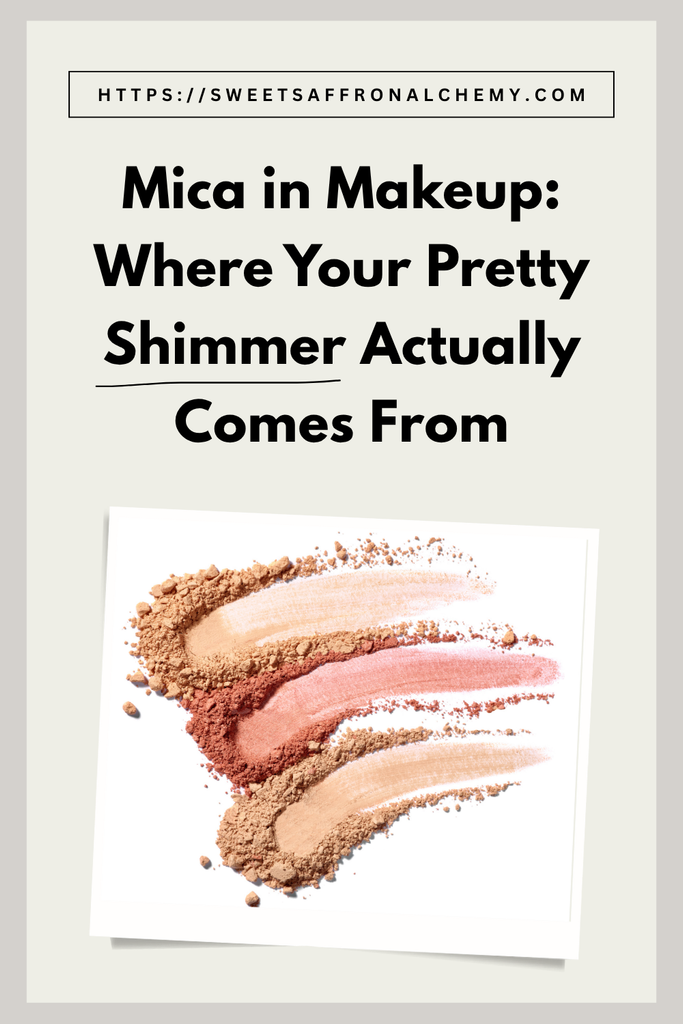
Mica is the name for a group of naturally occurring silicate minerals, prized for their shine and their ability to reflect light in thin, delicate sheets. That reflective quality is exactly why mica in makeup exists in the first place — it’s what gives your highlighter that glow, your eyeshadow that metallic finish, and your lipstick that subtle sheen instead of a flat, matte colour.
On an ingredient list, mica in makeup can be hiding under a few different names:
- mica
- potassium aluminium silicate
- CI 77019
- or occasionally sericite
If you see any of these on the back of your palette, that’s your shimmer source!
Where Does Mica in Makeup Come From?
This is where the story gets uncomfortable. The world’s highest-quality cosmetic-grade mica comes overwhelmingly from India — specifically the states of Jharkhand and Bihar — with additional supply from Madagascar, Brazil, Peru, Pakistan, Sri Lanka, and China. Roughly 60% of the high-quality mica used in cosmetics is estimated to originate from India alone.
A significant share of that Indian mica is extracted from unregulated, sometimes illegal mines, where workers dig by hand through narrow tunnels without protective gear.
Mica is not derived from animals. If you formulate color cosmetic products and add no animal-derived ingredients, you can call it vegan.
Who Is Mining It?
This is the part of the mica in makeup story that most brands would rather not put on a label. Investigations into these mining regions have repeatedly found children — some as young as 4 or 5 years old — working in mica mines, crawling into tunnels too narrow for adults, sifting through rock debris by hand.
Recent industry reporting estimates that roughly 10% of India’s mica mining workforce is still made up of children as of 2024, and the beauty industry coalition working to eliminate child labour from the supply chain — the Responsible Mica Initiative (RMI) — has pushed its original 2022 target all the way back to 2030.
Why Does the Industry Keep Using It?
Fair question, and an uncomfortable answer: mica in makeup is genuinely hard to replace at scale. It’s cheap, it’s abundant, it performs beautifully in formulation, and entire mining communities depend on it economically — which means an outright boycott isn’t the simple fix it sounds like.
Several major beauty conglomerates, including L’Oréal, Estée Lauder, Chanel, Shiseido, and Clarins, are RMI members working (at varying speeds) toward more traceable, audited sourcing. But traceability in a supply chain this fragmented is genuinely difficult — raw mica is frequently bought by middlemen and mixed together long before it ever reaches a cosmetic manufacturer, making it nearly impossible to verify origin unless a brand controls the chain directly.
Which Products Contain Mica?
Mica in makeup shows up far more widely than most people expect. Beyond the obvious — eyeshadow, highlighter, blush, bronzer, and lipstick — it’s also commonly found in:
- Nail polish
- Sunscreen (for that dewy, non-white-cast finish)
- Deodorant
- Shampoo and body lotion
- Toothpaste (yes, really — for a brighter appearance)
If a product has any kind of shimmer, glow, or metallic finish, there’s a strong chance mica is the reason.
How Can You Choose More Ethically?
There isn’t a perfect, guilt-free answer here, but there are meaningfully better choices:
Look for synthetic mica if it aligns with your philosophy? Lab-created mica — often listed as “synthetic fluorphlogopite” — is chemically near-identical to the natural version, delivers the same shimmer performance, and completely sidesteps the mining question. Brands like Lush have shifted to synthetic mica entirely for this reason.
Support RMI-member or Fair Trade-certified brands. Membership isn’t a perfect guarantee, but it does mean a brand is at least engaged in third-party auditing and traceability efforts, rather than staying silent on sourcing.
Ask the brand directly. If a company can’t tell you where their mica comes from or point you to a sourcing policy, treat that as a red flag rather than an oversight.
Don’t assume “natural” or “clean beauty” branding means ethically sourced. A product can be marketed as natural, vegan, or clean and still contain conflict-mined mica — the two labels aren’t related at all!
You can also look for certifications like Fair Trade, Ecocert or Cosmos.
Is Mica in Makeup Safe for Skin?
Yes — on the safety front, mica in makeup is considered non-irritating for topical use, with a comedogenicity rating of 0, meaning it won’t clog pores. The concern with mica has never really been a skin-safety issue; it’s an ethical sourcing and human rights issue, which is exactly why it deserves more attention than it usually gets in beauty content.
Mica Will Never Be “Organic” — And That’s Important to Understand
Here’s a nuance I want to clear up, because I see brands play fast and loose with it constantly: mica can be natural and can never be organic.
“Organic,” by definition, applies to living or once-living matter — plant and animal-derived materials that can be certified against organic farming standards. Mica is a mineral, mined out of rock. It has no biological origin at all, which means the entire concept of “organic mica” is a contradiction in terms, no matter how a brand markets it.
What mica can be is natural — meaning it comes from the earth in its raw mineral form, rather than being lab-synthesized. But even “natural” mica used in coloured cosmetics is nearly always processed afterward with iron oxides or other dyes to achieve specific shades, meaning even a “natural mica” claim on a vibrant eyeshadow isn’t as unprocessed as it sounds.
So if you ever see a brand advertise “organic mica” on packaging, that’s a marketing claim to raise an eyebrow at — not a certification that means anything.
The Bottom Line
Mica in makeup isn’t going anywhere anytime soon — it’s too effective, too embedded in the supply chain, and too economically important to mining communities for a simple switch-off. But understanding what mica actually is, where mica in makeup comes from, and why “organic mica” isn’t a real thing puts you in a much stronger position as a consumer.
Choose brands that are transparent about sourcing, lean toward synthetic mica where shimmer really matters to you, and don’t let a “natural” or “organic” label do your thinking for you.
Have questions about ethical sourcing in your own makeup bag? Drop them in the comments — I read every single one.

