
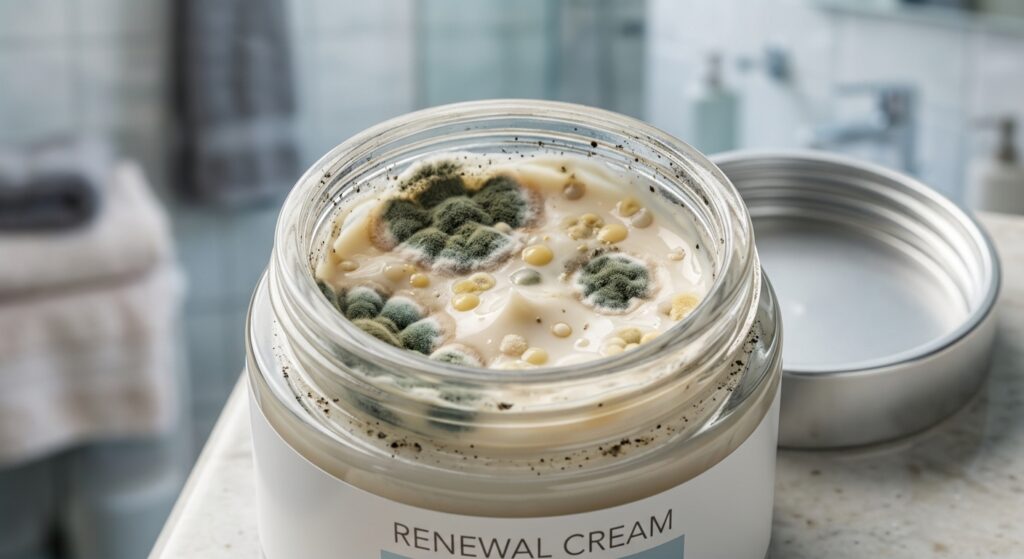
Are you one of those who think cosmetic preservatives are bad?
If you’ve ever read “preservative-free” on a jar of moisturizer and felt a tiny little wave of relief — I get it. It sounds clean. It sounds gentle. It sounds like the kind of thing we should want for our skin and our families.
But here’s the truth from the formulation side of things: when it comes to water-based skincare, “preservative-free” is often less of a perk and more of a warning sign. And that’s exactly why cosmetic preservatives matter so much.
Let’s break it down in plain English.
Who Needs Cosmetic Preservatives?
This is one of the biggest myths in skincare. People hear “preservatives” and think big factories, huge brands, science labs, and complicated regulations. But cosmetic preservatives matter just as much in a home kitchen as they do in a professional lab.
If your product contains water — even a little bit — you are now in the business of protecting that formula from mould, bacteria, and yeast. That applies to homemade face creams, lotions, toners, gels, and emulsions.
I always tell mums in my formulation classes: if you wouldn’t leave a bowl of cooked rice on the counter for three weeks and then feed it to your kids, don’t do the cosmetic version of that with skincare. Cosmetic preservatives aren’t a “fancy formulators only” ingredient. They’re a responsibility!
What Cosmetic Preservatives Actually Do
Cosmetic preservatives exist to stop harmful microbes from growing in products that can support microbial life. That includes anything water-based, and especially anything that gets dipped into with fingers, stored in a warm bathroom, or used around the eyes or on broken skin.
Not all cosmetic preservatives work the same way, which is why formulators choose carefully instead of tossing in one random ingredient and hoping for the best. Here are a few common categories:
Phenoxyethanol-based systems
These are widely used broad-spectrum cosmetic preservatives, often paired with ingredients like Ethylhexylglycerin to improve performance. They help protect against a range of bacteria and some fungi.
Organic acids such as Sodium Benzoate and Potassium Sorbate
These cosmetic preservatives are often marketed as “naturally derived,” though the versions used in formulation are usually synthesised for purity and consistency. They work best within specific pH ranges, so they have to match the formula properly.
Multifunctional preservative blends
These newer systems combine different ingredients that support preservation from more than one angle. They’re popular because they can offer broad protection without relying on older preservative classes alone. There are more options out there, including some older preservative systems that have fallen out of favour because of sensitization concerns. But these three give you a good snapshot of how varied cosmetic preservatives really are.
A word of caution: Baking Soda and Essential Oils are not preservatives!
Why Cosmetic Preservatives Are Necessary
Here’s the simple science: water is not just life for us — it’s life for microbes too. Any product with water in it can become a cozy little environment for mould, bacteria, and yeast. Warm, damp, nutrient-rich. Basically, a five-star hotel with terrible hygiene.
That’s why cosmetic preservatives are so important in creams, lotions, gels, serums, and anything else with a water phase. Without them, contamination can happen invisibly. A product may still look and smell fine while already being unsafe to use. Sneaky, rude, and definitely not cute.
This is also why most formulators don’t rely on just one preservative. Different microbes respond differently to different cosmetic preservatives. One ingredient might handle bacteria well but do very little against mould. A proper preservation system usually layers ingredients together so the formula has overlapping protection instead of one weak point.
How Cosmetic Preservatives Are Used
This is where formulation stops being a checklist and starts becoming a craft. Cosmetic preservatives are not “add 1% and move on” ingredients. The right percentage, pH range, and stage of addition depend on the exact preservative and the exact formula.
Some cosmetic preservatives are heat-stable and can be added during the heated water phase. Others are heat-sensitive and need to go in during cool-down. If you add them at the wrong stage, you can weaken or destroy the very thing meant to protect the product. The cream may still look beautiful, but beauty and safety are not the same thing.
That’s why technical data sheets matter. A real preservative decision should come from the supplier’s usage guidelines, not from a social media reel or a “just use this at 1%” shortcut. Cosmetic preservatives need context, not guessing.
Which Cosmetic Preservatives Should You Use?
There is no single “best” option. The right preservative system depends on the formula, the packaging, and the product’s purpose.
A facial mist has different needs than a rich body cream. A product for the eye area has different irritation considerations than a foot cream. A jar product has a higher contamination risk than a pump bottle because fingers keep visiting the party.
Your pH, water content, emulsion type, and target market all play a role too. That’s why choosing cosmetic preservatives is never one-size-fits-all. It’s about choosing the right system for that specific product, at that specific pH, doing that specific job.
Where Do Formulators Get Cosmetic Preservatives?
Most serious suppliers who serve DIY formulators and small brands provide cosmetic preservatives along with technical data sheets, certificates of analysis, and recommended usage rates. That information is not extra. It is essential.
If a supplier can’t tell you how the preservative works, what pH it needs, or how much to use, that’s not a great sign. When you’re making products for real skin — especially skin belonging to mums, babies, and busy families — the details matter.
Good cosmetic preservatives should come with good information. Otherwise, you’re basically assembling a safety system blindfolded. And no one needs that kind of excitement.
My supplier recommendations:
The Real Problem With “Preservative-Free”
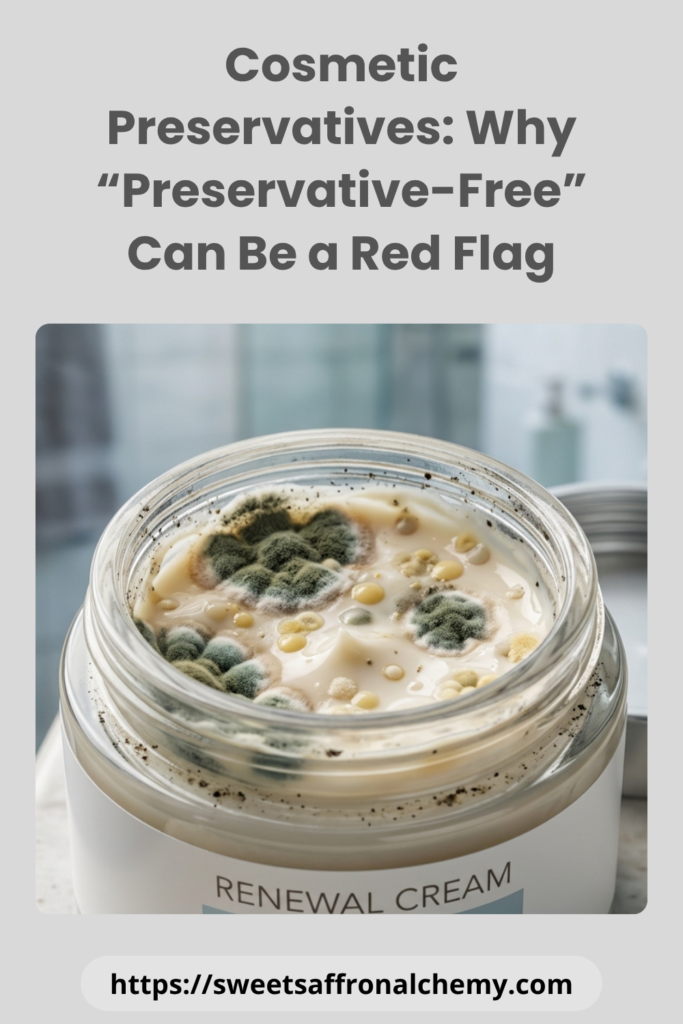
So let’s go back to the label that started all this. A truly water-containing product that is genuinely preservative-free is a contamination risk waiting to happen. Mould and bacteria don’t announce themselves politely. By the time you see fuzzy spots or smell something off, the product has often already been unsafe for a while.
And on skin, that can mean irritation, breakouts, stinging, infection, or a product that simply doesn’t belong near the eyes or broken skin. This is why cosmetic preservatives is not a dirty word. They are part of what makes a product safe to use.
“Preservative-free” sounds wholesome. But in water-based skincare, it can be a red flag that should make you super hyper alert – to stay away!
What About Oil-Based Products?
This is where things get a little more nuanced. Oil-only products don’t usually need antimicrobial cosmetic preservatives in the same way water-based products do, because microbes need water to grow. But that does not mean oil-only formulas need no protection at all.
Oils oxidize. Over time, exposure to air and light can make them go rancid. That’s why you’ll often see ingredients like Tocopherol (Vitamin E) or Rosemary extract in balms and facial oils. These are antioxidants, not cosmetic preservatives. They help protect oils from oxidation, not microbes from multiplication.
So even when a formula doesn’t need traditional cosmetic preservatives, it may still need a different type of protection.
“Self-Preserving” Is Not the Same as “Preservative-Free”
This is an important distinction, because these two get mixed up constantly. A truly self-preserving formula is intentionally designed to resist microbial growth through a combination of factors such as no water, low water activity, pH, packaging, and specific supporting ingredients.
That is not the same thing as a formula that simply skipped cosmetic preservatives and hoped for the best. One is carefully engineered and usually tested. The other is just missing a safety system.
If a brand uses the phrase “self-preserving,” that should mean the formula has been designed with real preservation strategy behind it — not that the brand wanted a cleaner-looking label.
Final Thought: Cosmetic Preservatives Are Part of Safe Formulation
So next time you see “preservative-free” on a skincare label, pause for a second and ask: is this product genuinely anhydrous or scientifically self-preserving, or is it water-based with nothing reliable protecting it?
That’s the kind of question that helps you shop more wisely and formulate more responsibly. And honestly, that’s the real win here. Not fear. Not trends. Just better decisions for your skin and your family.
Cosmetic preservatives aren’t the enemy. They’re one of the quiet little heroes making sure the products we love stay safe to use. And if you’re a mom juggling a hundred things at once, that’s one less thing you need to worry about.
Want more no-fluff cosmetic science broken down in plain English? Join the newsletter and get it straight to your inbox.

