
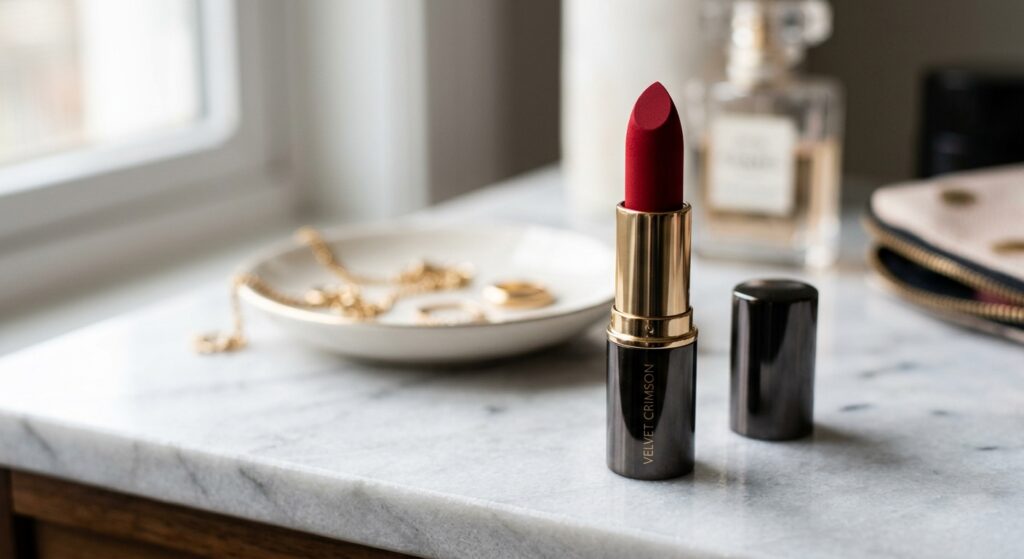
Babe, before you reach for your favourite tube this morning, let’s talk about the harmful ingredients in lipstick that you really love and can’t live the house without.
Lipstick sits in a strange category compared to the rest of your makeup bag. Unlike foundation or eyeshadow, a meaningful portion of what you put on your lips ends up ingested — licked off, absorbed through thin lip skin, or swallowed with your tea. That makes the question of harmful ingredients in lipstick a genuinely different conversation from “is this eyeshadow safe,” and honestly, one that deserves far more attention than it gets.
What Are the Harmful Ingredients in Lipstick?
The most well-documented concern around harmful ingredients in lipstick is heavy metal contamination — specifically Lead, Cadmium, Chromium, Aluminium, Manganese and Nickel. These aren’t ingredients brands intentionally add; they turn up as impurities in the raw pigments and waxes used to formulate colour cosmetics, particularly in darker, more saturated shades.
Beyond heavy metals, there’s a second tier of ingredients worth knowing:
- Parabens (methylparaben, propylparaben) — preservatives linked to hormone disruption concerns
- Synthetic fragrance — often hides undisclosed chemical mixtures behind the vague label “parfum”
- BHA and BHT — antioxidant preservatives flagged by some researchers as potential endocrine disruptors
- Phthalates — sometimes used to help colour bind and stay put, with growing concern around reproductive health
- PFAS (per- and polyfluoroalkyl substances) — increasingly found in long-wear and waterproof formulas, and notoriously slow to break down in the body

Why Should You Actually Care?
Here’s the number that changes the conversation for most people: the average lipstick wearer reapplies several times a day, and researchers estimate this adds up to tens of milligrams of product ingested daily.
Heavy metals like lead accumulate in the body over time rather than flushing out — meaning even trace exposure, repeated daily for years, can build into something worth worrying about.
Regulatory bodies generally argue the doses are too small to matter but plenty of independent researchers point out that cumulative, long-term exposure is exactly the kind of risk single-dose safety testing misses.
This is precisely why understanding harmful ingredients in lipstick matters more than most people assume — it isn’t about one application; it’s about the years of daily, repeated exposure most of us don’t think twice about.
Where Do These Harmful Ingredients in Lipstick Come From?
Most harmful ingredients in lipstick aren’t deliberately formulated in — they’re contamination, inherited from the raw materials themselves. Iron oxide pigments, mica-based shimmer, and certain waxes can carry trace heavy metals depending on where and how they were sourced and processed.
Regulation also varies enormously by country: the EU enforces stricter limits on heavy metals in cosmetics than the US, which means the exact same brand can be formulated to different safety standards depending on which market it’s sold in.
Which Lipstick Types Carry the Most Risk?
Not every lipstick is equally risky. A few patterns worth knowing:
- Darker, more pigmented shades (deep reds, plums, browns) tend to carry higher concentrations of heavy metals than sheer or lighter tints, simply because more pigment load means more opportunity for contamination.
- *Cheaper, unregulated, or unbranded lipsticks — particularly those bought from markets without proper safety testing — carry meaningfully higher risk than lipsticks from brands that publish third-party lab results.
- Long-wear and “transfer-proof” formulas are more likely to contain PFAS or heavier synthetic loads to achieve that staying power.
- Traditional lip and eye products sourced from certain unregulated markets have been repeatedly flagged for dangerously high lead content — worth being cautious with novelty or heritage products bought without safety certification.
*Take note:
By “cheaper, unregulated or unbranded lipsticks”, I do not refer to any specific brands or businesses both commercialized and small businesses. I am only referring to products that did not go through proper testing.
Who Should Be Most Cautious?
- Pregnant and breastfeeding mamas
- Young children who might mimic makeup application
- and anyone applying lipstick multiple times daily
You should be the most deliberate about checking for harmful ingredients in lipstick. If you’re someone who reapplies multiple times a day — which is more common than you’d think — your cumulative exposure is meaningfully higher than an occasional-wearer’s… even if each individual application seems negligible.
A Word on Essential Oils in Lip Products
Here’s one that catches a lot of DIY beauty lovers off guard — Essential Oils can be harmful to the lips too, even when they’re marketed as the “natural” choice.
Lip skin is far thinner and more absorbent than the rest of your face and lip products don’t actually need fragrance the way a body lotion might. What they need is flavour, which is a different category of ingredient entirely with its own safety standards for oral use.
This is exactly why most reputable DIY and Indie lip brands reach for Stevia or other lip-safe sweeteners instead of Essential Oils. EOs simply aren’t formulated or tested for repeated ingestion and their concentrated compounds can cause irritation, sensitization or a burning sensation on lip skin over time.
Essential Oils isn’t one of the harmful ingredients in lipstick… it just isn’t safe to the lips.
A Quick Reminder: Carmine Isn’t Halal
While we’re on the topic of what’s hiding in your lipstick — Carmine, the red-toned pigment derived from crushed cochineal insects, isn’t considered Halal.
It’s an incredibly common colourant in red and pink lipsticks, so if Halal-consciousness matters to you the way it does for our community here, it’s worth adding to your label-check list alongside the ingredients above. I’ve written a full breakdown on carmine specifically if you want to go deeper on that one.
Again, Carmine isn’t one of the harmful ingredients in lipstick… it just isn’t Halal. If your consumers aren’t Halal-conscious, you can continue to formulate with it.
And While You’re Checking Labels — Check the Brand Too
Ingredient safety isn’t the only thing worth researching before you buy. It’s just as important to know who you’re actually supporting with your money — steer clear of brands that fund or profit from genocide, human rights abuses, tests on animals – no matter how good the pigment payoff is!
Your purchasing power carries weight beyond your own lips.
How to Choose Safer Lipsticks
A few practical habits that actually make a difference:
- Favour lighter, sheerer formulas where pigment load therefore contamination risk is naturally lower.
- Look for brands that publish 3rd-party heavy metal testing. Transparency here is a genuinely good sign of a brand’s overall safety culture.
- Check the ingredient list for parabens, phthalates, and “parfum” rather than assuming a pretty package means a clean formula.
- Reduce reapplication frequency where you can.
- Be cautious with very cheap, unbranded lip products.
- Choose Halal-conscious formulas that skip Carmine and opt for mineral or plant-based reds instead.
- Support small business owners – they may not go through thorough tests due to high costs but usually home crafters use minimal ingredients and are more ‘straightforward’. For example, Candelilla wax instead of silicon film-formers.
A Little Something I’m Working On
I’ll let you in on something — I’ve been formulating my own lip products behind the scenes, and I may be sharing some of those formulas with you all in future. If building your own Halal-conscious, heavy-metal-free lip products from scratch is something you’d be interested in, keep an eye on this space.
I certainly do not use any harmful ingredients in lipstick… and in all my formulations!
The Bottom Line
You don’t need to throw out every lipstick in your collection today, but understanding the harmful ingredients in lipstick you’re wearing daily puts the power back in your hands. Favour transparency, favour lighter formulas where you can, skip Carmine if halal sourcing matters to you, and choose brands whose values you can actually stand behind.
Your lips — and everything you’re swallowing along with them — deserve that much thought.
Got a favourite lipstick you’d like me to break down the ingredients on? Send it my way, babe — I might just feature it.

