Okay babe, I need to have a real talk with you about something that’s been sitting on my heart for a while. It’s called Carmine.
Because I know how much you love your makeup. I know the thrill of a gorgeous red lipstick or a beautiful rosy blush — and I’m not here to take that joy away from you.
I am here to make sure you know what’s actually in the products you’re putting on your face every single day.
Today, we’re talking about carmine. And by the end of this post, I promise you’ll never look at a red or pink lipstick the same way again.
So What Exactly Is Carmine?
Carmine is a vivid red pigment that’s been used in cosmetics — and food — for centuries. It gives products that beautiful, rich red-to-pink colour that’s incredibly hard to replicate with anything else. It’s stable, it’s vibrant, and it photographs beautifully.
And it’s made from insects.
Specifically, carmine is produced by crushing the female cochineal insect — a tiny beetle found on prickly pear cacti in South and Central America. These insects are harvested, dried in the sun, and crushed to extract carminic acid from their bodies and eggs, creating the bright red dye.
To make carmine dye, thousands of female cochineal bugs are harvested, killed, dried, and crushed into a reddish powder. In fact, it takes about 155,000 insects to make just one kilogram of cochineal!
That beautiful red lipstick? That rosy blush? Built on thousands of crushed bugs.
I know. Take a moment.
The Many Names It Hides Behind
This is where it gets sneaky. Carmine doesn’t always show up on ingredient lists as “carmine.” Brands use several names for the same ingredient, and if you don’t know what to look for, you’ll miss it entirely.
Here’s what to watch out for on labels:
- Carmine
- Cochineal extract
- CI 75470
- E120
- Natural Red 4
- Crimson Lake
- Carminic Acid
Carmine can be listed on ingredient labels as “cochineal extract,” “crimson lake,” “natural red 4,” “C.I. 75470” or simply “carmine.”
Any of these on the ingredient list means the same thing: insect-derived red dye.
Screenshot this list. Save it. Take it shopping with you!
Which Famous Brands Use It?
This is the part that hurts a little — because some of the brands we love, the ones on our wish lists and in our Sephora bags, are using carmine regularly.
A quick search on leading beauty retailer websites reveals hundreds of products that feature carmine, including blush from Stila, eyeshadow from Fenty Beauty, and lip colour from Maybelline, MAC, Chanel, and dozens more mass, prestige, and luxury brands.
Let me name a few specifically:
MAC Cosmetics — one of the most beloved brands among makeup lovers — uses carmine in a wide range of its lip products and blushes. It’s listed openly in their ingredient decks, but unless you know what CI 75470 means, you’d walk right past it.
NARS — uses carmine in many of its lip products, including their iconic “Dragon Girl” and “Cruella” shades. These deep reds are fan favourites, but they are not halal-compliant due to the inclusion of carmine.
Lancôme — many of Lancôme’s lipsticks, including their “L’Absolu Rouge” range, use carmine to produce their deep red and pink shades.
Chanel — “Rouge Allure” and “Rouge Coco” lipsticks achieve their signature vibrancy using carmine.
Estée Lauder — the “Pure Color Envy” lipstick line includes several shades that contain carmine.
Charlotte Tilbury — a brand many of us adore. Charlotte Tilbury confirmed that carmine is used across their K.I.S.S.I.N.G Lipsticks, Matte Revolution Lipsticks, Lip Lustre Glosses, Cheek to Chic Blushers, Colour Chameleons, Beach Sticks, and several Luxury Eyeshadow Palettes.
This isn’t shade-throwing at these brands — they’re not doing anything illegal! Please do not quote my words and defame me. Carmine is totally safe to be used in cosmetics formulations both skincare and makeup. In fact, carmine is an approved, regulated cosmetic ingredient globally.
But as a Muslimah, we need to use Halal-certified or Halal-compliant products. Fullstop.
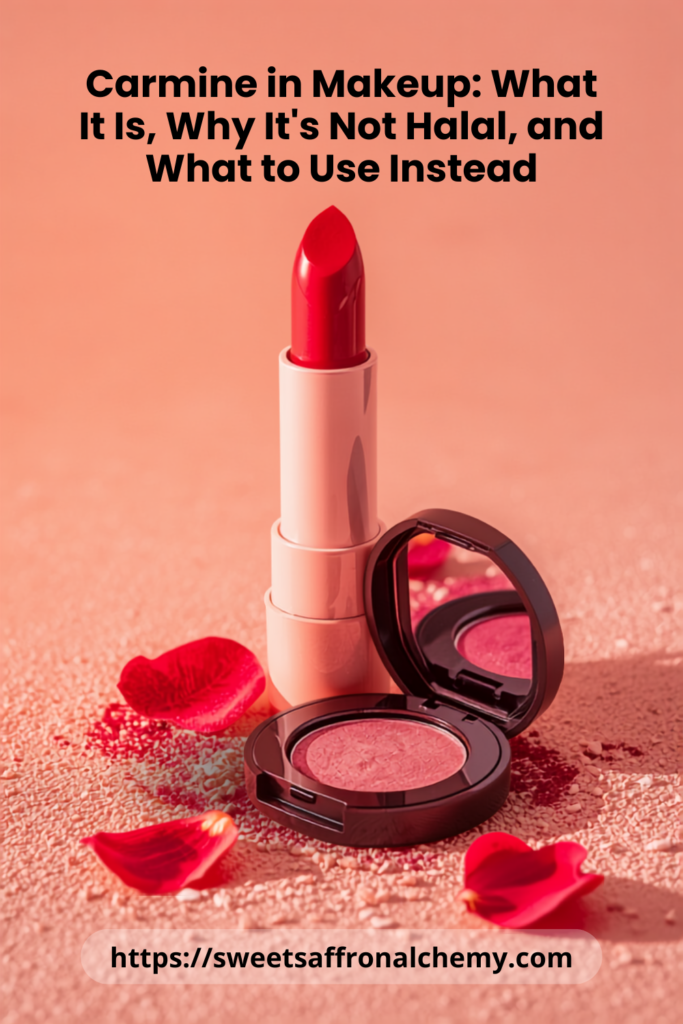
Is Carmine Halal? Let’s Be Clear
The answer is No. And I want to explain this properly, not just hand you a one-word answer.
In the Hanafi, Shafi’i, and Hanbali Mazhabs, consuming insects is not permissible. Insects are classified as khabith — repulsive or impure — and therefore haram to consume.
Since carmine is essentially boiled insect extract, it is strictly forbidden across all 4 Mazhabs.
Now here’s where it gets nuanced — and I think it’s important to be honest about this rather than oversimplify. For external cosmetics like eyeshadow, blush, or shampoo: The pigment itself is considered ritually pure — meaning it does not contaminate or invalidate wudu if it’s on the skin or clothing. For this reason, using carmine in externally applied products is generally deemed permissible in the Hanafi Mazhab.
But for lipstick and lip balm: Lipsticks and lip balms containing carmine are impermissible due to potential ingestion. When you wear lipstick, you inevitably consume trace amounts — when you eat, drink, lick your lips. This is where the clear ruling applies: lipstick containing carmine is not halal-compliant.
There is a difference of opinion among scholars — the Maliki Mazhab, as well as some modern halal authorities like Indonesia’s MUI, consider cochineal permissible, comparing it to the permissibility of eating grasshoppers. (Yes, grasshoppers are halal 😁)
I present this not to confuse, but because I believe in giving you the full picture. You follow the scholars and the Mazhab that guides you, and you make your own informed choice.
What I can say clearly is this: if you are consciously trying to live and consume in a halal way, carmine in lipstick is something you will want to avoid. And for those of us committed to a fully halal lifestyle, the approach of ihtiyath — a precaution — means we don’t apply it anywhere on the face.
But It’s “Natural” — Isn’t That Good?
This is the irony that I find genuinely frustrating as a formulator. Carmine is often marketed as a “natural” alternative to synthetic dyes. And yes, it comes from a natural source. But natural does not automatically mean better, safer, or more ethical.
Let alone being Halal. I do not own the divine rulings – Hukum, it truly belongs to ☝️.
Beyond the halal concern, carmine is also a known allergen. There are documented cases of people experiencing contact dermatitis, redness, and even anaphylactic reactions to carmine — particularly in lip products where repeated daily contact and ingestion occurs.
Sensitive skin types take note: if you’ve been having unexplained reactions to lipstick, this might be why.
What Do Formulators Like Me Use Instead?
This is the part I love — because the alternatives are genuinely good. You don’t have to sacrifice colour payoff to go carmine-free.
Iron oxides are the gold standard halal alternative. They’re mineral-derived, stable, and produce a full range of reds, pinks, corals, and browns. Most certified halal cosmetic brands use iron oxides as their primary colourant. As a formulator, it’s my favourite!
Beetroot extract produces beautiful pinks and deep reds and has the added benefit of being skin-loving and antioxidant-rich.
Lycopene (from tomatoes) and anthocyanins (from berries and red cabbage) are plant-based red pigments increasingly used in clean and halal cosmetics.
Synthetic dyes like Red 40 (Allura Red) often confuse people — Red 40 is a synthetic, petroleum-based dye. It is artificial and halal-compliant. Carmine is “natural” but insect-derived. The two are very different.
Modern formulation has come so far that there is absolutely no reason a halal lipstick needs to sacrifice on richness or vibrancy.
If you want to find out about the latest colorants, SpecialChem is a good platform to browse.
Halal Makeup Brands Worth Knowing
If you’re ready to audit your makeup bag — and I highly recommend you do — here are some brands that are carmine-free and worth exploring:
INGLOT — widely available, beloved by makeup artists globally, and carries halal-certified products including their famous Freedom System customisable palettes. Great for colour lovers.
Sampure Minerals — a halal-certified, vegan, and cruelty-free brand offering foundations, lipsticks, blushers, and more. All mineral-based, gentle on skin.
Tuesday in Love — halal-certified by ISNA Canada, carmine-free across their range. Their lipstick line is growing and genuinely pigmented.
INIKA Organic — certified organic and halal, with a beautiful range of lip colours using plant and mineral pigments. A clean beauty favourite.
Wardah Cosmetics — hugely popular across Southeast Asia, Indonesian-founded, and fully halal-certified. Widely available online and increasingly in regional retailers.
When shopping any brand, always check the full ingredient list — not just the marketing claims.
Look for the absence of CI 75470, E120, cochineal extract, crimson lake, and carmine. And look for recognized halal certification logos on packaging: JAKIM, IFANCA, or ISNA are among the most credible.
A Final Word From Me
As a certified cosmetic formulator and a Muslimah, this topic is close to my heart. Because I believe we deserve beauty that doesn’t ask us to compromise our values — and the good news is, we really don’t have to anymore.
The halal beauty space has grown enormously. The options are beautiful, the formulations are sophisticated, and the colours are just as gorgeous. You’re not giving anything up. You’re just making better choices.
Check your makeup bag. Read your labels. And remember — knowing what’s in your products isn’t being difficult. It’s being informed.
Did you find carmine hiding in any of your current makeup? Drop it in the comments — I’d love to know, and honestly, you might help a friend figure it out too.