
When Everything Feels Too Heavy, Say Astaghfirullah
You know that feeling. The alarm goes off, and before your feet have even touched the floor, your mind is already running. There are messages to answer, bills to settle, little ones to get ready, and a to-do list that seems to grow whenever you look away. By midday your shoulders are tight, your patience is thin, and you snap at someone you love. By evening you are lying awake replaying the day, wishing you had been kinder, calmer, better.
Some days the heaviness has no clear cause at all. Your heart simply feels cloudy, as if a fine layer of dust has settled over it.
If that sounds familiar, you are not alone, and you are certainly not broken. Our hearts were never designed to carry everything by themselves. Islam gives us a beautiful, gentle reset button, and it is only one word away: Astaghfirullah.
In this post, we will explore what Astaghfirullah means, why it holds such a special place in Islam, and how it can soften your heart, ease your mind and, in sha Allah, enhance your aura hundreds of times over when it is practised alongside Husnuzon, your daily prayers and your adhkar.
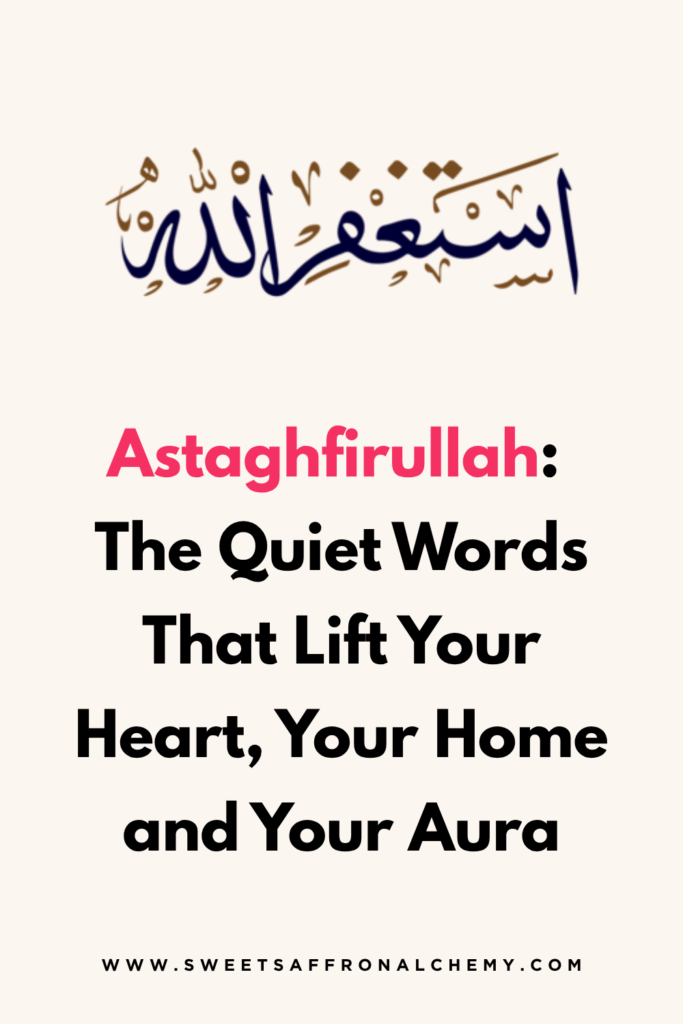
What Does Astaghfirullah Mean?
Astaghfirullah (أستغفر الله) means “I seek forgiveness from Allah.”
The word comes from the Arabic root gh-f-r, which carries the sense of covering, protecting and shielding. This is a lovely detail, because it tells us that forgiveness in Islam is not only about erasing a mistake. It is about Allah covering us with His mercy, shielding us from the consequences of what we have done and protecting us from repeating it.
The act of seeking forgiveness is known as Istighfar. When we say Astaghfirullah, we are doing something much deeper than saying “sorry”. We are:
- Acknowledging that we are human and that we fall short
- Turning back to the One who is always ready to receive us
- Asking Allah to cover our faults and cleanse our hearts
- Admitting that we need His mercy, which is one of the most humble and beautiful states a person can be in
Many Muslims say Astaghfirullah after an obvious mistake, such as a harsh word or a missed prayer. But it is just as powerful as an everyday habit, a gentle reflex of the tongue that keeps the heart soft and mindful throughout the day.
Why Astaghfirullah Matters in Islam
Seeking forgiveness is not a side note in our faith. It is woven through the Quran and the life of the Prophet Muhammad ﷺ.
The Prophet ﷺ was the most beloved of creation, and his past and future sins had been forgiven, yet he would still seek forgiveness from Allah more than seventy times a day (narrated in Sahih al-Bukhari). In another narration, he mentioned seeking forgiveness one hundred times a day (Sahih Muslim). If the best of humankind made Istighfar such a constant companion, how much more do we need it?
The Quran also speaks of Istighfar with remarkable tenderness. In Surah Nuh (71:10-12), Prophet Nuh (Noah) ﷺ tells his people to seek forgiveness from their Lord, for He is ever Forgiving, and promises that doing so brings abundant rain, an increase in wealth and children, gardens and flowing rivers. It is a beautiful reminder that Istighfar is linked not only to the Hereafter but also to blessings and ease in this life.
Surah Ali Imran (3:135) describes those who, when they commit a wrong or wrong themselves, remember Allah and seek forgiveness for their sins. The message is clear: stumbling is human, and returning is what makes us beloved.
And perhaps the most comforting truth of all is this: Allah loves to forgive. His mercy is vast, and no one who sincerely turns to Him is turned away.
The Benefits of Astaghfirullah
Istighfar is a gift that keeps giving. Here are some of the ways it can enrich your life, in sha Allah.
Spiritual Benefits
It cleanses the heart. Sins and heedlessness can leave marks on the heart, much like dust on a mirror. Astaghfirullah polishes that mirror, bringing back clarity and sincerity in worship.
It draws you closer to Allah. Every time you say it, you are choosing to turn towards Him. That small, repeated turning builds a relationship of trust and nearness.
It invites mercy and blessings. As in Surah Nuh, seeking forgiveness is connected with barakah, meaning the blessing and ease that Allah places in our time, our provision and our relationships.
It builds humility. Istighfar reminds us that we are always in need of Allah, which protects us from arrogance and self-righteousness.
Emotional Benefits
It releases guilt. Guilt that has nowhere to go becomes a heavy burden. Istighfar gives it a place to go. When you hand your mistakes to Allah and trust in His mercy, you are allowed to put the weight down.
It softens the inner voice. Instead of spiralling into harsh self-criticism, istighfar replaces it with something kinder: “I made a mistake, I am sorry, and I trust my Lord to forgive me.”
It brings calm. Repeating Astaghfirullah slowly and with presence has a grounding effect. Many people find it settles a racing mind in the same way a few deep breaths would, though with the added comfort of remembrance of Allah.
(A gentle note: Istighfar is a beautiful support for the heart, but it is not a substitute for professional help. If you are struggling with your mental health, please also reach out to a doctor or counsellor.)
Lifestyle Benefits
It improves how you treat others. A heart that regularly asks for forgiveness finds it easier to forgive. You become gentler in your speech, quicker to apologise and slower to hold grudges.
It creates a rhythm of mindfulness. Saying Astaghfirullah throughout the day turns ordinary moments, such as stirring the pot, waiting in traffic or rocking a baby, into small acts of worship.
It brings an inner glow. And this is where things get really interesting.
Astaghfirullah and Your Aura
At Sweet Saffron Alchemy, we talk a lot about aura. Not as something mystical or separate from our faith, but as the light, energy and presence you carry. You know the type of person who walks into a room and instantly makes everyone feel calm and welcome? That is a radiant aura, and it is built from the inside out.
A heart weighed down by unresolved guilt, resentment and heedlessness tends to show it. It appears in our tone, our posture, our patience, even the tiredness in our eyes. A heart that is regularly cleansed, humble and connected to Allah carries itself differently. There is a softness, a steadiness, a quiet light.
Astaghfirullah is one of the most beautiful ways to clear that inner clutter. But here is the secret that makes it so powerful: Istighfar does not work alone. It shines brightest when it is combined with three other pillars.
- Husnuzon (Having Good Thoughts of Allah & His Creations)
Husnuzon billah means holding a good opinion of Allah. It is believing, deep down, that He is Merciful, that He hears you, and that His plan for you is better than anything you could have chosen.
In a hadith qudsi, Allah says, “I am as My servant expects Me to be.” This changes everything about how we say Astaghfirullah. Without Husnuzon, Istighfar can feel like a ritual of fear, repeated while doubting that we will ever be forgiven. With Husnuzon, it becomes a conversation of hope: “Ya Allah, I am coming back to You because I know You will welcome me.”
That hope is what turns guilt into light. A heart that expects goodness from its Lord begins to radiate that expectation outwards.
- Your Daily Prayers
Our five daily prayers are the backbone of a Muslim’s day. They are appointments with Allah that interrupt the noise of the world and bring us back to what matters. The Prophet ﷺ compared the five prayers to a flowing river outside one’s door in which a person bathes five times a day, leaving no dirt upon them (Sahih al-Bukhari and Sahih Muslim).
When you pray consistently, and you say Astaghfirullah within and after your prayers, you are layering cleansing upon cleansing. The Prophet ﷺ himself would seek forgiveness three times immediately after finishing the obligatory prayer. Your day becomes punctuated with moments of renewal, and your aura is refreshed again and again.
- Adhkar (Daily Remembrance)
Adhkar, the remembrance of Allah through morning and evening supplications, post-prayer dhikr, and simple phrases like SubhanAllah, Alhamdulillah and Allahu Akbar, keep the heart connected throughout the day. The Quran reminds us that it is in the remembrance of Allah that hearts find rest (13:28).
Where Istighfar clears away the dust, adhkar fills the space with light. Together they create a heart that is both clean and illuminated.
The Hundredfold Effect
So, what happens when Astaghfirullah is practised with Husnuzon, steady daily prayers and regular adhkar? Think of it as a spiritual synergy. Each element strengthens the others:
- Husnuzon gives your istighfar hope and sincerity
- Prayer gives it structure and consistency
- Adhkar gives it constant companionship through the day
- Astaghfirullah keeps the whole system cleansed and humble
Many sisters and brothers describe the result as a heart that feels lighter, a face that looks brighter and a presence that feels warmer to others. In sha Allah, as these habits grow, your aura can be enhanced not just a little, but hundreds of times over, in the sense that the light you carry becomes deeper, calmer and more noticeable to everyone around you.
Only Allah knows the true measure of reward, and we ask Him to accept our small efforts and multiply them.
How to Practise Astaghfirullah Daily
The beauty of Istighfar is its simplicity. You do not need any special equipment, a quiet room or even much time. Here are some easy ways to weave it into your day:
- After every obligatory prayer: say Astaghfirullah three times, following the Sunnah, before moving on to your other adhkar.
- After wudhu: let each splash of water be a reminder to cleanse the heart as well as the body.
- In moments of mistake or irritation: pause and say Astaghfirullah instead of reacting.
- During everyday tasks: while commuting, washing dishes, folding laundry or applying your skincare, let your tongue stay moist with Istighfar.
- Before sleep: reflect on your day, forgive others, ask Allah to forgive you, and end the night with a clean heart.
- In the last third of the night: if you are able to wake for Tahajjud, this is a special time that Allah praises those who seek forgiveness.
A Short Daily Ritual: The 5-Minute Aura Reset
If you would like a simple routine to begin with, try this gentle evening ritual. It pairs beautifully with your night-time self-care.
- Settle. After Isha, wash your face and hands mindfully. As the water touches your skin, take a slow breath and set the intention to return to Allah.
- Reflect. Sit quietly for one minute. Gently recall the moments of your day where you fell short. Do this without harshness, simply with honesty.
- Seek forgiveness. Say Astaghfirullah slowly, 33x or 100x, thinking about the meaning of each repetition. Let it come from the heart, not just the tongue.
- Husnuzon. Pause and remind yourself: “My Lord is Most Forgiving, Most Merciful. He is always better to me than I deserve.”
- Adhkar. Recite your evening adhkar, Ayatul Kursi and the three Quls, and close with a heartfelt dua for yourself and your loved ones.
- Rest. Apply your skincare in a calm, unhurried way, thanking Allah for the day, and go to sleep in a state of peace.
Do this consistently for a few weeks and notice how you feel. Many people find their evenings become calmer, their mornings lighter and their hearts more open.
Sayyidul Istighfar: The Master Supplication for Forgiveness
Among all the forms of Istighfar, one is given a very special title: Sayyidul Istighfar, the master or leader of seeking forgiveness. It is a complete supplication of gratitude, humility and hope, found in Sahih al-Bukhari.
Arabic:
اللَّهُمَّ أَنْتَ رَبِّي لَا إِلَهَ إِلَّا أَنْتَ، خَلَقْتَنِي وَأَنَا عَبْدُكَ، وَأَنَا عَلَى عَهْدِكَ وَوَعْدِكَ مَا اسْتَطَعْتُ، أَعُوذُ بِكَ مِنْ شَرِّ مَا صَنَعْتُ، أَبُوءُ لَكَ بِنِعْمَتِكَ عَلَيَّ، وَأَبُوءُ بِذَنْبِي فَاغْفِرْ لِي فَإِنَّهُ لَا يَغْفِرُ الذُّنُوبَ إِلَّا أَنْتَ
Meaning:
“O Allah, You are my Lord. There is no god but You. You created me and I am Your servant, and I keep Your covenant and promise as best I can. I seek refuge in You from the evil of what I have done. I acknowledge Your favour upon me, and I acknowledge my sin, so forgive me, for none forgives sins except You.”
The Prophet ﷺ said that whoever recites it during the day with firm faith in it and passes away that day before evening will be among the people of Paradise, and likewise for whoever recites it at night with firm faith and passes away before morning.
Notice how this supplication already contains Husnuzon: it begins by affirming Allah as our Lord and Creator, acknowledges His blessings, admits our own shortcomings, and ends with complete trust that only He can forgive. It is a perfect example of how humility and hope belong together.
A lovely habit is to recite Sayyidul Istighfar once in the morning and once in the evening as part of your adhkar. If the Arabic feels difficult at first, start by learning it a line at a time, and read the meaning alongside so that your heart is fully present.
A Gentle Call to Action
Let us start small, together. Today, try just one of these:
- Say Astaghfirullah 3x after your next prayer, with full presence
- Try the 5-Minute Aura Reset tonight
- Learn the first line of Sayyidul Istighfar and build from there
Then come back and tell me how it felt. Leave a comment below, share this post with a sister or friend who might need a little light today, and let us encourage one another on this journey.
May Allah forgive us, cover our faults, purify our hearts and make us among those whose light shines from within. Ameen.
Astaghfirullah, Astaghfirullah, Astaghfirullah.
With love, light and a little saffron, Yati Sweet Saffron Alchemy: Aura. Beauty. Chemistry.